


Page 325 - The Book of Caterpillars: A Life-Size Guide to Six Hundred Species From Around the World
P. 325
MOTH CATERPILLARS

                      FAMILY  Zygaenidae
                  DISTRIBUTION  Across Europe to western Turkey and the Caucasus, and as far
                           east as the Urals

                     HABITAT  Dry slopes, cli  tops, dry grasslands, and alpine meadows up to
                           6,600 ft (2,000 m) elevation
                  HOST PLANTS  Low-growing plants, including Lathyrus spp., clover (Trifolium
                           spp.), and vetch (Vicia spp.)
                      NOTE  Hairy caterpillar that has distinctive rows of black spots
             CONSERVATION STATUS  Not evaluated, but regionally rare


                                                                                   ADULT WINGSPAN
                                                                                 1 ⁄  –1  ⁄   in (30–46 mm)
                                                                                  CATERPILLAR LENGTH
            ZYGAENA LONICERAE                                                       1 ⁄   in (30 mm)
            NARROW-BORDERED
            FIVE-SPOT BURNET                                                                     323

            (SCHEVEN, 1777)


            The female Narrow-bordered Five-spot Burnet moth lays her
            creamy-yellow and slightly oval eggs in large clusters around
            stems and under leaves. The hatched caterpillars feed through
            summer and then overwinter, emerging to feed again in spring
            and pupate in May. Like other Zygaena species, a proportion
            of the caterpillars remain in diapause for the second or even
            third winter to reduce the risk of an entire generation being
            wiped out by adverse weather. The mature larvae pupate on
            the vegetation, spinning a creamy-yellow, elongated cocoon.
            The pupa is dark brown.


            The day- ying moths, with their bright, red-spotted wings, are
            often mistaken for butter ies. They have a variable appearance,

            and there are a number of subspecies. The moths are on the wing
            in June and July with a single generation. Zygaena lonicerae is
            often confused with the Five-spot Burnet (Z. trifolii), which  ies

            at the same time in similar habitats.


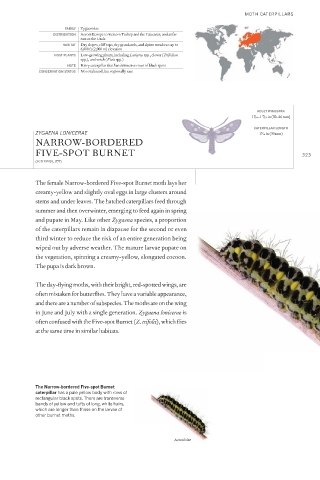
            The Narrow-bordered Five-spot Burnet
            caterpillar has a pale yellow body with rows of
            rectangular black spots. There are transverse
            bands of yellow and tufts of long, white hairs,
            which are longer than those on the larvae of
            other burnet moths.


                                                         Actual size

