


Page 328 - The Book of Caterpillars: A Life-Size Guide to Six Hundred Species From Around the World
P. 328
MOTH CATERPILLARS

                                                     FAMILY  Tortricidae
                                                 DISTRIBUTION  Every continent, except Antarctica
                                                    HABITAT  Stored grain or nut facilities, households, warehouses;
                                                          can survive and breed outdoors among nut trees


                                                     HOSTS  Foodstu s, including  our, cereals, dried fruits, nuts,
                                                          and chocolate
                                                      NOTE  Common household pest that gives caterpillars a bad name
                                             CONSERVATION STATUS  Not evaluated, but abundant


            ADULT WINGSPAN
            ½–¾ in (13–20 mm)
           CATERPILLAR LENGTH
            ⅜–½ in (10–12 mm)
                                                                        PLODIA INTERPUNCTELLA
                                                          INDIAN MEAL MOTH
    326
                                                                                   (HÜBNER, [1813])


                                            Indian Meal Moth caterpillars can be found year-round indoors,
                                            and in food processing and storage facilities. The life cycle can
                                            be completed in three weeks under optimal temperatures—
                                            86–95°F (30–35°C)—so there may be more than 12 generations
                      Actual size
                                            annually. Females lay 60 to 400 pinhead-sized, white, sticky
                                            eggs on food surfaces, which hatch in 2 to 14 days, depending on
                                            temperature. The caterpillars feed on the surface of grain, nuts,
                                            and  our, trailing silken threads that bind food, frass, and cast


                                            skins together. There are  ve to seven instars, and last instars
                                            pupate in a thin, white cocoon from which adult moths emerge
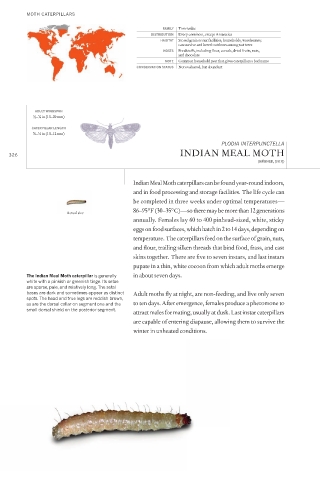
          The Indian Meal Moth caterpillar is generally   in about seven days.
          white with a pinkish or greenish tinge. Its setae
          are sparse, pale, and relatively long. The setal

          bases are dark and sometimes appear as distinct   Adult moths  y at night, are non-feeding, and live only seven
          spots. The head and true legs are reddish brown,
          as are the dorsal collar on segment one and the   to ten days. After emergence, females produce a pheromone to
          small dorsal shield on the posterior segment.  attract males for mating, usually at dusk. Last instar caterpillars
                                            are capable of entering diapause, allowing them to survive the
                                            winter in unheated conditions.

