


Page 322 - The Book of Caterpillars: A Life-Size Guide to Six Hundred Species From Around the World
P. 322
MOTH CATERPILLARS

                                                     FAMILY  Zygaenidae
                                                 DISTRIBUTION  Across Europe and Russia to Russian Far East and Japan
                                                    HABITAT  Forests, scrub, and heathlands
                                                  HOST PLANTS  Bog-rosemary (Andromeda polifolia), bilberry (Vaccinium spp.),
                                                          Heather (Calluna vulgaris), and Prunus spp.
                                                      NOTE  Small, slug-shaped caterpillar that has tufts of white hairs
                                             CONSERVATION STATUS  Not evaluated, but classed as endangered in parts of its range


            ADULT WINGSPAN
           ⅞–1⅓
 in (22–26 mm)


           CATERPILLAR LENGTH
            ¾–1 in (20–25 mm)
                                                                              RHAGADES PRUNI
                                           BLACKTHORN AURORA MOTH
    320
                                                                          (DENIS & SCHIFFERMÜLLER, 1775)


                                            The caterpillars of the Blackthorn Aurora Moth hatch from
                                            yellow, conical-shaped eggs laid either singly or in small groups
                                            on the host plants. The larvae feed on leaves and buds and
                                            overwinter in the vegetation, becoming active again in spring.
                                            After a period of further growth, the caterpillars pupate on the
                                            host plant, spinning a white, boat-shaped cocoon.


                                            The day- ying moths are butter y-like with an eye-catching

                                            metallic blue body and dark wings. They are seen in June and
                                            July, and there is a single generation. The female moths stay

                                            close to the place where they eclosed, while the males  y over
                                            greater distances. The adults do not feed. Unusually, Rhagades

                                            pruni is found in very di erent habitats, ranging from heathland
                                            and bogs, dry bushy slopes, and grasslands to woodland and
                                            hedgerow. They are under threat from the loss of scrub, drainage
                                            of bogs, reforestation, and general development.


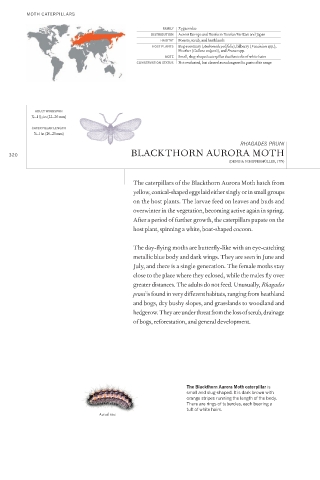
                                                             The Blackthorn Aurora Moth caterpillar is
                                                             small and slug-shaped. It is dark brown with
                                                             orange stripes running the length of the body.
                                                             There are rings of tubercles, each bearing a
                                                             tuft of white hairs.
                                 Actual size

