


Page 333 - The Book of Caterpillars: A Life-Size Guide to Six Hundred Species From Around the World
P. 333
MOTH CATERPILLARS

                      FAMILY  Cimeliidae
                    TRIBUTION
                  DISTRIBUTION  Southern Greece
                  DISTRIBUTION
                  DIS
                     HABIT
                        A
                     HABITAT T  Hot, dry slopes with sparse vegetation
                     HABITAT
                  HOST PLANTS S  Euphorbia spp.
                    T PLANT
                  HOS
                  HOST PLANTS
                      NOTE
                      NOTE
                      NO TE  Little-known green caterpillar that is found in Greece
                       A
                       TUS
                  A
                   TION S
                      T
             CONSERV
             CONSERVATION STATUS  Not evaluated
             CONSERVATION STATUS
                                                                                   ADULT WINGSPAN
                                                                                  1 ⁄  –1
⁄   in (27–33 mm)
                                                                                  CATERPILLAR LENGTH
                                                                                   ⁄  –¾ in (15–20 mm)
            AXIA NESIOTA
            AXIA NESIOTA                                                                         331
            REISSER, 1962
            Axia nesiota caterpillars hatch from eggs laid on the host plants,
            which are found growing in dry, rocky, often hot habitats. The
            larvae are active from fall, all through winter, and into early
            spring, pupating from February to May. The pupa estivates
            during the hot summer months and ecloses in the cooler
            fall temperatures.

            The adult moths are on the wing from September to November,
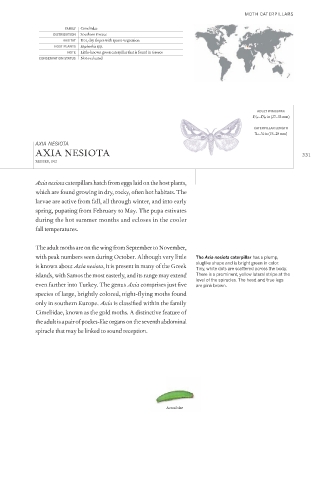
            with peak numbers seen during October. Although very little   The Axia nesiota caterpillar has a plump,
            is known about Axia nesiota, it is present in many of the Greek   sluglike shape and is bright green in color.
                                                                Tiny, white dots are scattered across the body.
            islands, with Samos the most easterly, and its range may extend   There is a prominent, yellow lateral stripe at the

            even farther into Turkey. The genus Axia comprises just  ve   level of the spiracles. The head and true legs
                                                                are pink brown.
            species of large, brightly colored, night-flying moths found
            only in southern Europe. Axia is classi ed within the family

            Cimeliidae, known as the gold moths. A distinctive feature of
            the adult is a pair of pocket-like organs on the seventh abdominal
            spiracle that may be linked to sound reception.


                                                      Actual size

