


Page 334 - The Book of Caterpillars: A Life-Size Guide to Six Hundred Species From Around the World
P. 334
MOTH CATERPILLARS

                                                     FAMILY  Drepanidae
                                                 DISTRIBUTION  Southern Greece, southern Balkans, Ukraine,
                                                          and Asia Minor to Pakistan
                                                    HABITAT  Warm, dry, open scrub
                                                  HOST PLANTS  Hawthorn (Crataegus spp.), Blackthorn (Prunus spinosa),
                                                          plum (Prunus spp.), and apple (Malus spp.)
                                                      NOTE  Caterpillar of a recently recognized species resembling others
                                                          of its genus
                                             CONSERVATION STATUS  Not evaluated


            ADULT WINGSPAN
           ¾–
⁄   in (19–24 mm)
           CATERPILLAR LENGTH
            ⁄  –⅝ in (14–16 mm)                                                 CILIX ASIATICA
                                                             EASTERN CHINESE
                                                                       CHARACTER
    332
                                                                                  O. BANG-HAAS, 1907


                                            The Eastern Chinese Character caterpillar hatches and feeds on
                                            much the same range of host plants as the very similar Chinese
                                            Character (Cilix glaucata), of which, until 1987, it was thought
                                            to be an eastern subspecies. However, the Eastern Chinese
                                            Character is restricted to dry, hot places, and so has a more
                                            southerly distribution than the Chinese Character. Cilix asiatica
                      Actual size
                                            larvae can be found from May to late October, and there are
                                            likely to be three broods annually in most places. Like that of
                                            the Chinese Character, the pupation site is probably leaf litter
                                            or a bark crevice, with the species overwintering in this stage.


                                            The Eastern Chinese Character species was  rst found in Europe
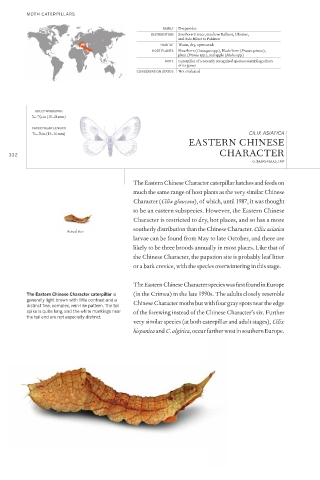
          The Eastern Chinese Character caterpillar is   (in the Crimea) in the late 1990s. The adults closely resemble
          generally light brown with little contrast and a   Chinese Character moths but with four gray spots near the edge
          distinct   ne, complex, vein-like pattern. The tail
          spike is quite long, and the white markings near   of the forewing instead of the Chinese Character’s six. Further
          the tail end are not especially distinct.
                                            very similar species (at both caterpillar and adult stages), Cilix
                                            hispanica and C. algirica, occur farther west in southern Europe.

