


Page 335 - The Book of Caterpillars: A Life-Size Guide to Six Hundred Species From Around the World
P. 335
MOTH CATERPILLARS

                      FAMILY  Drepanidae
                  DISTRIBUTION  Across Europe, east to the Urals and Asia Minor
                     HABITAT  Scrub, woodlands, hedgerows, and gardens
                  HOST PLANTS  Mainly hawthorn (Crataegus spp.) and Blackthorn (Prunus
                           spinosa); also plum (Prunus spp.) and other woody Rosaceae,
                           including apple (Malus spp.), Bramble (Rubus fruticosus),
                           and Rowan (Sorbus aucuparia)
                      NOTE  Solitary caterpillar that mimics a shriveled leaf
             CONSERVATION STATUS  Not evaluated, but common throughout most of its range


                                                                                   ADULT WINGSPAN
                                                                                    ⁄  –1 ⁄   in (17–27 mm)
                                                                                  CATERPILLAR LENGTH
                                                                                   ⁄  –  ⁄   in (15–18 mm)
            CILIX GLAUCATA
            CHINESE CHARACTER                                                                    333

            (SCOPOLI, 1763)


            The Chinese Character caterpillar can be found from May
            to October in a wide variety of habitats where its food plants
            occur. The roughly oval eggs are laid singly on the leaves,
            where the solitary caterpillars will then feed openly and
            rest with their spiky tail end raised. They pupate in a strong,
            brown, silken cocoon spun among the leaves or in a bark         Actual size
            crevice on the food plant. Like that of other drepanine moths,
            the pupa is covered in a pale, waxy bloom. Pupae of the later
            broods overwinter.


            Cilix glaucata is the most widespread of the four Cilix species
            recognized in Europe and the Middle East. The adults, which
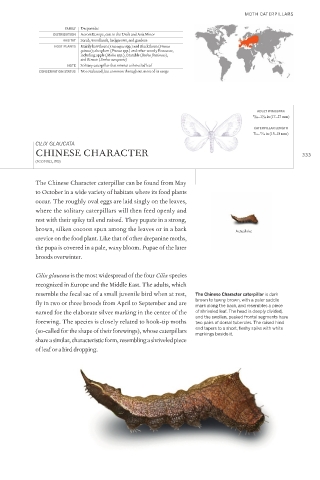
            resemble the fecal sac of a small juvenile bird when at rest,   The Chinese Character caterpillar is dark
            fly in two or three broods from April to September and are   brown to tawny brown, with a paler saddle
                                                               mark along the back, and resembles a piece
            named for the elaborate silver marking in the center of the   of shriveled leaf. The head is deeply divided,
            forewing. The species is closely related to hook-tip moths   and the swollen, peaked frontal segments have
                                                               two pairs of dorsal tubercles. The raised hind
            (so-called for the shape of their forewings), whose caterpillars   end tapers to a short,   eshy spike with white
                                                               markings beside it.
            share a similar, characteristic form, resembling a shriveled piece
            of leaf or a bird dropping.

