


Page 336 - The Book of Caterpillars: A Life-Size Guide to Six Hundred Species From Around the World
P. 336
MOTH CATERPILLARS

                                                     FAMILY  Drepanidae
                                                 DISTRIBUTION  Europe, east to the Urals, and northeast Asia
                                                    HABITAT  Forests, heathland, scrub, and other wooded areas,
                                                          including gardens
                                                  HOST PLANTS  Birch (Betula spp.) and alder (Alnus spp.)
                                                      NOTE  Common hook-tip caterpillar that is found in many habitats
                                             CONSERVATION STATUS  Not evaluated, but common throughout most of its range


            ADULT WINGSPAN
           1 ⁄  –1 ⁄   in (30–40 mm)
           CATERPILLAR LENGTH
             ⁄  –
⁄   in (18–24 mm)
                                                                           DREPANA FALCATARIA
                                                              PEBBLE HOOK-TIP
    334
                                                                                   (LINNAEUS, 1758)


                                            Pebble Hook-tip caterpillars hatch from eggs laid in short chains
                                            on the leaves of their host plant. They are solitary, each making
                                            a slight silken shelter when small, but live openly on the leaves
                                            when larger. The larvae often rest with the hind end raised and
                                            the front end arched so that the tubercles protrude. They can be
                      Actual size
                                            found in almost any habitat within their range, from late May to
                                            October. Pupation occurs in a tough, brown cocoon constructed
                                            either in a rolled-up leaf or between two leaves joined together,
                                            and this is the overwintering stage.


                                            The species is named for the pebble mark on the forewing of
                                            the adults, which  y from April to September (or May to July

                                            in the north of the range). Hook-tips are members of the
                                            subfamily Drepaninae, whose characteristic caterpillars have a

                                            single  eshy spike that has evolved from the hind pair of prolegs.
                                            The Dusky Hook-tip caterpillar (Drepana curvatula) is similar in
                                            appearance to D. falcataria and also feeds on birch and alder, but
                                            it has shorter tubercles and is generally slightly darker in color.


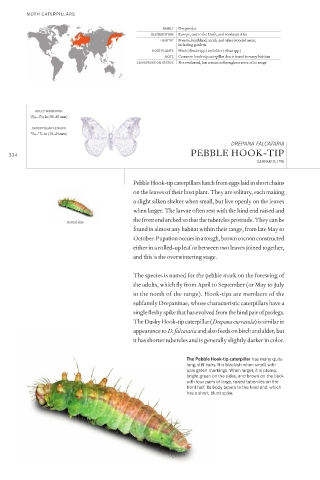
                                                             The Pebble Hook-tip caterpillar has many quite
                                                             long, sti   hairs. It is blackish when small, with
                                                             pale green markings. When larger, it is plump,
                                                             bright green on the sides, and brown on the back
                                                             with four pairs of large, raised tubercles on the
                                                             front half. Its body tapers to the hind end, which
                                                             has a short, blunt spike.

