


Page 338 - The Book of Caterpillars: A Life-Size Guide to Six Hundred Species From Around the World
P. 338
MOTH CATERPILLARS

                                                     FAMILY  Drepanidae
                                                 DISTRIBUTION  From western Europe and North Africa (Algeria) across
                                                          temperate Asia, east to Japan, and south to Borneo and Sumatra
                                                    HABITAT  Forests, scrub, hedgerows, and gardens
                                                  HOST PLANTS  Bramble (Rubus fruticosus), Dewberry (Rubus caesius),
                                                          and Raspberry (Rubus idaeus)
                                                      NOTE  Seldom seen caterpillar of a familiar moth
                                             CONSERVATION STATUS  Not evaluated, but common throughout most of its range


            ADULT WINGSPAN

           1⅜–1¾ in (35–44 mm)

           CATERPILLAR LENGTH
           1⅛–1
⁄   in (28–33 mm)
                                                                               THYATIRA BATIS
                                                                PEACH BLOSSOM
    336
                                                                                   (LINNAEUS, 1758)


                                            Peach Blossom caterpillars hatch from eggs laid either singly
                                            or in small groups on the leaves of its host plant. When young,
                                            the larva resembles a bird dropping and, so disguised, lives
                                            on the upper side of the leaves. When the caterpillar is larger,
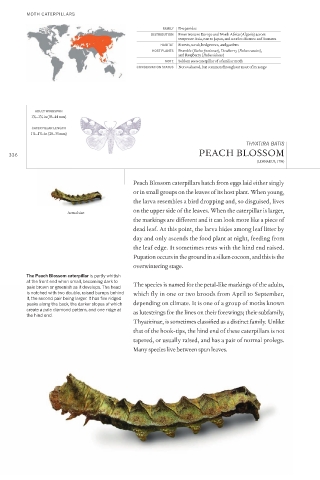
                       Actual size

                                            the markings are di erent and it can look more like a piece of
                                            dead leaf. At this point, the larva hides among leaf litter by
                                            day and only ascends the food plant at night, feeding from
                                            the leaf edge. It sometimes rests with the hind end raised.
                                            Pupation occurs in the ground in a silken cocoon, and this is the
                                            overwintering stage.
         The Peach Blossom caterpillar is partly whitish
         at the front end when small, becoming dark to   The species is named for the petal-like markings of the adults,
         pale brown or greenish as it develops. The head
         is notched with two double, raised bumps behind   which fly in one or two broods from April to September,
         it, the second pair being larger. It has   ve ridged
         peaks along the back, the darker slopes of which   depending on climate. It is one of a group of moths known
         create a pale diamond pattern, and one ridge at   as lutestrings for the lines on their forewings; their subfamily,
         the hind end.

                                            Thyatirinae, is sometimes classi ed as a distinct family. Unlike
                                            that of the hook-tips, the hind end of these caterpillars is not
                                            tapered, or usually raised, and has a pair of normal prolegs.
                                            Many species live between spun leaves.

