


Page 337 - The Book of Caterpillars: A Life-Size Guide to Six Hundred Species From Around the World
P. 337
MOTH CATERPILLARS

                      FAMILY  Drepanidae
                  DISTRIBUTION  North America, from southern Canada to southern United States
                     HABITAT  Moist forests, woodlands, and shrublands
                  HOST PLANTS  Alder (Alnus spp.), birch (Betula spp.), oak (Quercus spp.),
                           poplar (Populus spp.), and willow (Salix spp.)
                      NOTE  Wrinkly caterpillar that is found in silked-up leaf shelters
             CONSERVATION STATUS  Not evaluated


                                                                                   ADULT WINGSPAN
                                                                                 1⅝–1  ⁄   in (41–43 mm)
                                                                                  CATERPILLAR LENGTH
                                                                                  1¼–1⅜ in (32–35 mm)


            PSEUDOTHYATIRA CYMATOPHOROIDES
            TUFTED THYATIRIN                                                                     335
            (GUENÉE, 1852)


            Tufted Thyatirin caterpillars hatch from eggs laid by the
            female moth on a wide range of deciduous trees. The larvae are
            solitary and feed alone, usually by night, on a range of hardwood

            shrubs and trees; those in the Paci c northwest are said to favor
            members of the rose (Rosaceae) family. The caterpillars form    Actual size
            shelters by tying together the edges of one or more adjacent
            leaves and rest concealed within them. When disturbed, the
            caterpillars drop to the ground and curl up, sometimes emitting
            clear  uid from the mandibles as a defensive ploy. The species

            overwinters as a pupa within a cocoon spun in leaf litter.


            The adults are nocturnal and their  ight period extends from

            early June to September. The species is generally single-
            brooded but may have a partial second brood in the south. Flies
            (tachinids) frequently parasitize this caterpillar, with maggots
            developing internally. The Tufted Thyatirin is the only member
            of its genus, Pseudothyatira.


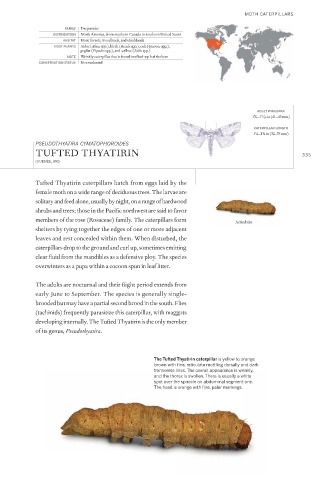
                                                  The Tufted Thyatirin caterpillar is yellow to orange
                                                  brown with   ne, reticulate mottling dorsally and dark
                                                  transverse lines. The overall appearance is wrinkly,
                                                  and the thorax is swollen. There is usually a white
                                                  spot over the spiracle on abdominal segment one.
                                                  The head is orange with   ne, paler markings.

