


Page 339 - The Book of Caterpillars: A Life-Size Guide to Six Hundred Species From Around the World
P. 339
MOTH CATERPILLARS

                      FAMILY  Drepanidae
                  DISTRIBUTION  From Europe to the Urals, Asia Minor, and the Caspian Sea
                     HABITAT  Forests, hedgerows, parks, and gardens
                  HOST PLANTS  Oak, including Pedunculate Oak (Quercus robur), Sessile Oak
                           (Quercus petraea), and Downy Oak (Quercus pubescens)
                      NOTE  Caterpillar that adopts a characteristic hook-tip, arched pose
             CONSERVATION STATUS  Not evaluated, but common throughout most of its range


                                                                                   ADULT WINGSPAN
                                                                                  ⅞–1⅜ in (22–35 mm)


                                                                                  CATERPILLAR LENGTH
                                                                                   ⅞–1 in (22–25 mm)
            WATSONALLA BINARIA
            OAK HOOK-TIP                                                                         337

            (HUFNAGEL, 1767)


            The Oak Hook-tip caterpillar ecloses from oval eggs that are
            initially green but turn red before hatching and are laid on the
            leaf edge. It lives openly and rests with its head and its tail end
            raised in the usual hook-tip manner, often with the head held     Actual size
            high, the front end arched, and the tail spike pointing upward.
            The caterpillars are present from June to October. The pale
            brown pupa, which has a waxy bloom, is formed in a whitish,
            mesh-like cocoon within a folded leaf or leaves drawn together
            and overwinters there.


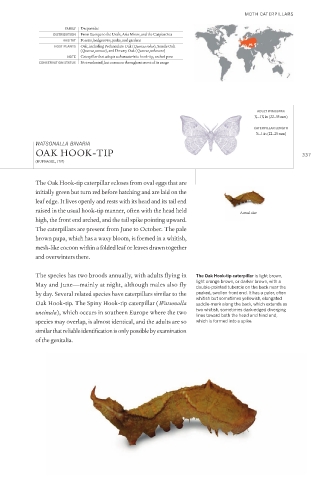
            The species has two broods annually, with adults flying in   The Oak Hook-tip caterpillar is light brown,
            May and June—mainly at night, although males also fly   light orange brown, or darker brown, with a
                                                                double-pointed tubercle on the back near the
            by day. Several related species have caterpillars similar to the   peaked, swollen front end. It has a paler, often
            Oak Hook-tip. The Spiny Hook-tip caterpillar (Watsonalla   whitish but sometimes yellowish, elongated
                                                                saddle-mark along the back, which extends as
            uncinula), which occurs in southern Europe where the two   two whitish, sometimes dark-edged diverging
                                                                lines toward both the head and hind end,
            species may overlap, is almost identical, and the adults are so   which is formed into a spike.
            similar that reliable identi cation is only possible by examination

            of the genitalia.

