


Page 340 - The Book of Caterpillars: A Life-Size Guide to Six Hundred Species From Around the World
P. 340
MOTH CATERPILLARS

                                                     FAMILY  Drepanidae
                                                 DISTRIBUTION  United Kingdom and western Europe, east to the Urals and south
                                                          to the Caspian Sea
                                                    HABITAT  Forests, hedgerows, parklands, and gardens
                                                  HOST PLANTS  European Beech (Fagus sylvatica)
                                                      NOTE  Hook-tip caterpillar that is found on beech trees
                                             CONSERVATION STATUS  Not evaluated, but probably common throughout most
                                                          of its range


            ADULT WINGSPAN


           ⅞–1⅜ in (22–35 mm)
           CATERPILLAR LENGTH
            ¾–⅞ in (19–22 mm)
                                                                        WATSONALLA CULTRARIA
                                                            BARRED HOOK-TIP
    338
                                                                                   (FABRICIUS, 1775)


                                            The Barred Hook-tip caterpillar hatches on the leaf of its host
                                            plant from oval eggs that are yellowish green when  rst laid but

                                            later turn reddish. Like other hook-tips, it lives openly, being
                                            well disguised as a piece of dead leaf or bird dropping. The
                                            caterpillars are present throughout their range between June
                      Actual size
                                            and October. The blue-gray pupa, which has a waxy bloom,
                                            is formed in a pale, quite dense cocoon within a folded leaf or
                                            leaves drawn together and overwinters there.


                                            The caterpillar of this species is very similar to that of the Oak
                                            Hook-tip (Watsonalla binaria), but it is slightly slimmer and
                                            more inclined to be reddish in color (although there are several
                                            different color forms), and the double-pointed tubercle on
                                            the back of the peaked, swollen front section is smaller. The
                                            geographical ranges of the two species are also much the same.

                                            However, as their food plants are di erent, the two are unlikely
                                            to be confused in the wild.


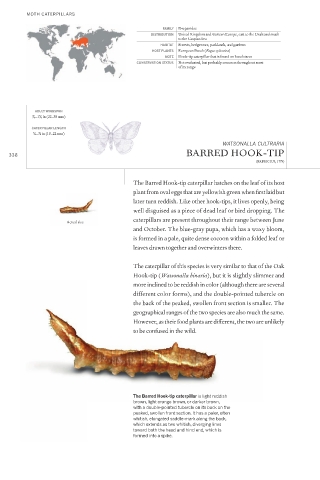
                                            The Barred Hook-tip caterpillar is light reddish
                                            brown, light orange brown, or darker brown,
                                            with a double-pointed tubercle on its back on the
                                            peaked, swollen front section. It has a paler, often
                                            whitish, elongated saddle-mark along the back,
                                            which extends as two whitish, diverging lines
                                            toward both the head and hind end, which is
                                            formed into a spike.

