


Page 341 - The Book of Caterpillars: A Life-Size Guide to Six Hundred Species From Around the World
P. 341
MOTH CATERPILLARS

                      FAMILY  Lasiocampidae
                  DISTRIBUTION  European Alps, Scandinavia
                     HABITAT  Upland coniferous forests and moors, and scree slopes with
                           low-growing shrubs
                  HOST PLANTS  Various, including alder (Alnus spp.), birch (Betula spp.),
                           Vaccinium spp., and willow (Salix spp.)
                      NOTE  Brown, hairy caterpillar of limited distribution
             CONSERVATION STATUS  Not evaluated


                                                                                   ADULT WINGSPAN
                                                                                 1¼–1  ⁄   in (31–43 mm)
                                                                                  CATERPILLAR LENGTH
                                                                                  ¾–⅞ in (20–22 mm)
            ERIOGASTER ARBUSCULAE
            DWARF BIRCH SPINNER                                                                  339

            FREYER, 1849


            Dwarf Birch Spinner caterpillars hatch from eggs laid by the
            female moth in large clusters on the host plants. The larvae
            stay together, spinning a communal silken tent over the leaves
            and stems of the plant during June and July. They feed in the
            safety of the web, but on sunny days they can be seen basking in   Actual size
            the sun. After their  nal molt, the caterpillars become solitary.

            To pupate, they drop to the ground and spin a tough, pale
            yellow cocoon that lies in the leaf litter or just beneath the soil
            surface. They overwinter in their cocoons.


            The adult moths eclose and are on the wing in May and June,
            usually the following year with a single generation. If the
            conditions are unfavorable, however, it is not unusual for
            the species to overwinter for more than one year to increase its
            chances of survival. While the silken webs of the caterpillars are
            a relatively common sight within their range, the night- ying

            moths are rarely observed.


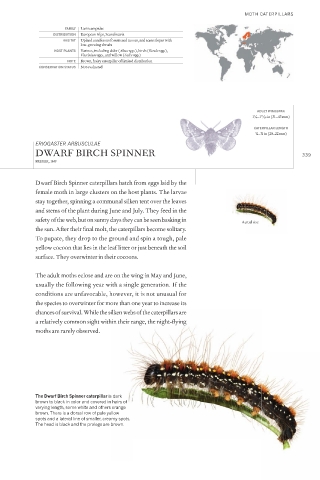
            The Dwarf Birch Spinner caterpillar is dark
            brown to black in color and covered in hairs of
            varying length, some white and others orange
            brown. There is a dorsal row of pale yellow
            spots and a lateral line of smaller, creamy spots.
            The head is black and the prolegs are brown.

