


Page 342 - The Book of Caterpillars: A Life-Size Guide to Six Hundred Species From Around the World
P. 342
MOTH CATERPILLARS

                                                     FAMILY  Lasiocampidae
                                                 DISTRIBUTION  Parts of southern Europe and central Europe, from Spain to the
                                                          Balkans, and into southern Russia
                                                    HABITAT  Limestone grasslands, hedgerows, and forest margins
                                                  HOST PLANTS  Various trees and shrubs, especially Blackthorn (Prunus spinosa);
                                                          also on birch (Betula spp.), hawthorn (Crateagus spp.), poplar
                                                          (Populus spp.), and oak (Quercus spp.)
                                                      NOTE  Hairy caterpillar that lives with others on a silken web

                                             CONSERVATION STATUS  Data de cient, formerly endangered


            ADULT WINGSPAN

           1 ⁄  –1⅜ in (27–35 mm)

           CATERPILLAR LENGTH
           2–2⅛ in (50–55 mm)
                                                                             ERIOGASTER CATAX
                                                                EASTERN EGGAR
    340
                                                                                   (LINNAEUS, 1758)


                                            The caterpillars of the Eastern Eggar moth hatch from eggs
                                            laid in batches of around 150 to 200 on branches and then
                                            covered in gray hairs from the adult female’s abdomen. The
                                            larvae overwinter and hatch the following spring, living together
                                            gregariously on a silken, gray web, jerking their heads when
                                            threatened to deter would-be predators. Older caterpillars move
                                            away, become solitary, and pupate in a cocoon.


                                            The moths are on the wing from September until November,
                                            and there is a single generation. The species was once classed
                                            as endangered but is no longer at risk across the eastern part of
                                            its range, although still rare elsewhere. The adults are seldom
                                            seen, but the caterpillars are easily spotted. Much of the threat
                                            to Eriogaster catax comes from the loss of its habitat through

                                            agricultural intensi cation and clearance of hedgerows, plus
                                            the use of insecticides on trees with an infestation of hairy

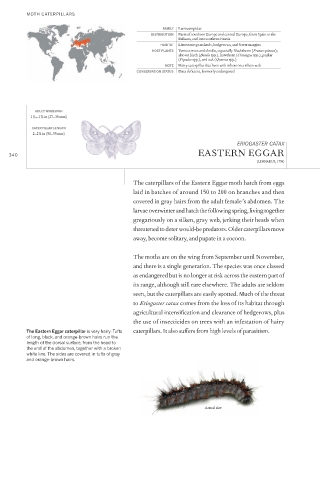
         The Eastern Eggar caterpillar is very hairy. Tufts   caterpillars. It also su ers from high levels of parasitism.
         of long, black, and orange-brown hairs run the
         length of the dorsal surface, from the head to
         the end of the abdomen, together with a broken
         white line. The sides are covered in tufts of gray
         and orange-brown hairs.


                                                                  Actual size

