


Page 348 - The Book of Caterpillars: A Life-Size Guide to Six Hundred Species From Around the World
P. 348
MOTH CATERPILLARS

                                                     FAMILY  Lasiocampidae
                                                 DISTRIBUTION  Western Europe, the Middle East, and east to central and
                                                          northeast Asia
                                                    HABITAT  Acid moorlands, lowland heaths, calcareous grasslands,
                                                          sand dunes, and open woodlands
                                                  HOST PLANTS  Many shrubs, including Bramble (Rubus fruticosus),
                                                          Heather (Calluna vulgaris), Bilberry (Vaccinium myrtillus),
                                                          Sea-buckthorn (Hippophae rhamnoides), and willow (Salix spp.);
                                                          also herbaceous plants, such as clovers (Trifolium spp.)
                                                      NOTE  Large, very furry caterpillar that basks in spring sunshine
                                             CONSERVATION STATUS  Not evaluated


            ADULT WINGSPAN
           2⅛–3⅛ in (55–80 mm)
           CATERPILLAR LENGTH
           2⅜–2¾ in (60–70 mm)
                                                                          MACROTHYLACIA RUBI
                                                                          FOX MOTH
    346
                                                                                   (LINNAEUS, 1758)


                                            Fox Moth caterpillars hatch in late June or July from light gray,
                                            brown-marbled eggs laid in clusters, often on plant stems, fences,
                                            or rocks. The larva feeds until fall and hibernates fully fed,
                                            on or slightly under the ground, unprotected but curled up under
                                            dense moss or other litter. It emerges brie y in spring and can

                                            then be found basking in sunshine, before it pupates low down
                                            in the vegetation in a thin, elongated, grayish cocoon.


                                            This caterpillar is most often found in fairly extensive areas of
                                            open, rough, agriculturally unimproved mosaics of grassland
                                            and scrub rather than in shady forests, farmland, or urban
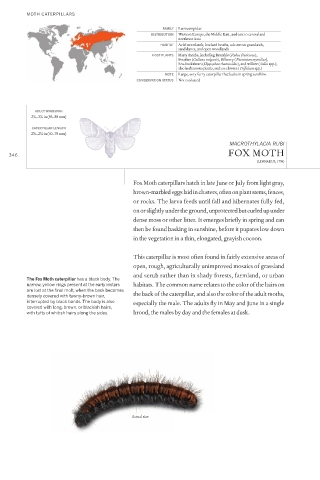
          The Fox Moth caterpillar has a black body. The
          narrow, yellow rings present at the early instars   habitats. The common name relates to the color of the hairs on
          are lost at the   nal molt, when the back becomes
          densely covered with tawny-brown hair,   the back of the caterpillar, and also the color of the adult moths,

          interrupted by black bands. The body is also   especially the male. The adults  y in May and June in a single
          covered with long, brown, or blackish hairs,
          with tufts of whitish hairs along the sides.   brood, the males by day and the females at dusk.


                                           Actual size

