


Page 347 - The Book of Caterpillars: A Life-Size Guide to Six Hundred Species From Around the World
P. 347
MOTH CATERPILLARS

                      FAMILY  Lasiocampidae
                  DISTRIBUTION  Europe and North Africa, east to Central Asia
                     HABITAT  Woodlands, heathlands, and sand dunes
                  HOST PLANTS  Various, including Heather (Calluna vulgaris), trefoil
                           (Trifolium spp.), grasses, and trees such as oak (Quercus spp.)
                           and poplar (Populus spp.)
                      NOTE  Hairy caterpillar found on a variety of food plants
             CONSERVATION STATUS  Not evaluated, but locally scarce


                                                                                   ADULT WINGSPAN
                                                                                  1 ⁄  –2⅛ in (40–55 mm)
                                                                                  CATERPILLAR LENGTH
                                                                                  2–2⅜ in (50–60 mm)
            LASIOCAMPA TRIFOLII
            GRASS EGGAR                                                                          345

            DENIS & SCHIFFERMÜLLER, 1775


            Female Grass Eggar moths lay their gray-brown, oval eggs in a
            cluster, usually on the underside of leaves. The eggs overwinter
            and hatch the following spring. The caterpillars feed on a range
            of plants by night and seek shelter during the day. When mature,
            the larvae crawl down to the ground to pupate, often burrowing
            under leaf litter or into the soil. The adults emerge a few weeks

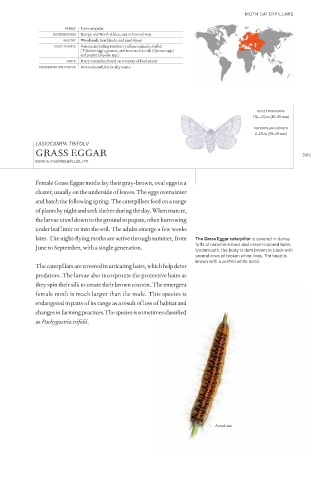
            later. The night- ying moths are active through summer, from   The Grass Eggar caterpillar is covered in dense
            June to September, with a single generation.       tufts of caramel-brown and cream-colored hairs.
                                                               Underneath, the body is dark brown to black with
                                                               several rows of broken white lines. The head is
                                                               brown with a central white band.
            The caterpillars are covered in urticating hairs, which help deter
            predators. The larvae also incorporate the protective hairs as
            they spin their silk to create their brown cocoon. The emergent
            female moth is much larger than the male. This species is
            endangered in parts of its range as a result of loss of habitat and
            changes in farming practices.The species is sometimes classi ed

            as Pachygastria trifolii.


                                                                      Actual size

