


Page 344 - The Book of Caterpillars: A Life-Size Guide to Six Hundred Species From Around the World
P. 344
MOTH CATERPILLARS

                                                     FAMILY  Lasiocampidae
                                                 DISTRIBUTION  From United Kingdom and western Europe to Russia, Siberia,
                                                          and Japan
                                                    HABITAT  Mostly damp places, including marshes, fens, open areas in forests,
                                                          and on moorlands
                                                  HOST PLANTS  Coarse grasses (Poaceae), sedges (Carex spp.), and Common Reed
                                                          (Phragmites australis)
                                                      NOTE  Striking, large, hairy caterpillar that is fond of drinking dew
                                             CONSERVATION STATUS  Not evaluated, but probably common within most of its range


            ADULT WINGSPAN
           2–2¾ in (50–70 mm)
           CATERPILLAR LENGTH
           2⅜–2¾ in (60–70 mm)
                                                                            EUTHRIX POTATORIA
                                                                            DRINKER
    342
                                                                                   (LINNAEUS, 1758)


                                            The Drinker caterpillar lives in tall, mainly damp grassland and
                                            is named for its habit of drinking drops of dew or rainwater.
                                            The whitish, gray-marked eggs are laid in small groups
                                            attached to grass stems. The caterpillar, while small, hibernates
                                            near the ground in dense grasses and feeds, mainly at night,
                                            the following spring. It is often seen resting on grasses by day,
                                            and contact should be avoided as the hairs can cause skin rashes.
                                            The caterpillar pupates in a yellowish, papery, tapered cocoon
                                            low down among grass stems.


                                            The large, furry, chestnut-brown or orange-brown adults  y

                                            from June to August in a single brood. The Lasiocampidae
                                            (often known as eggars and lappets) are medium-sized to large
                                            moths found in most parts of the world. The caterpillars all have
                                            a dense covering of short hairs and tufts of longer hairs. Many
                                            are conspicuous by day but, due to the hairs, are not eaten by
                                            most birds, except cuckoos.


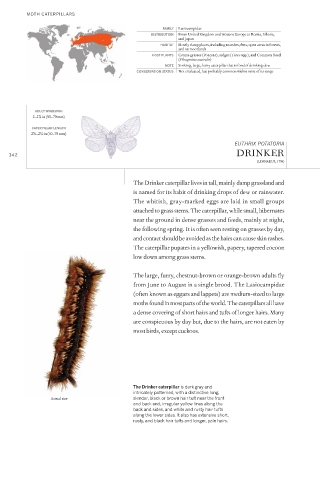
                                            The Drinker caterpillar is dark gray and
                                            intricately patterned, with a distinctive long,
                 Actual size                slender, black or brown hair tuft near the front
                                            and back end, irregular yellow lines along the
                                            back and sides, and white and rusty hair tufts
                                            along the lower sides. It also has extensive short,
                                            rusty, and black hair tufts and longer, pale hairs.

