


Page 350 - The Book of Caterpillars: A Life-Size Guide to Six Hundred Species From Around the World
P. 350
MOTH CATERPILLARS

                                                     FAMILY  Lasiocampidae
                                                 DISTRIBUTION  Across Canada and United States
                                                    HABITAT  Deciduous woodlands
                                                  HOST PLANTS  Deciduous trees, including oak (Quercus spp.),
                                                          Maple (Acer saccharum), aspen (Populus spp.),
                                                          and Paper Birch (Betula papyrifera)
                                                      NOTE  Widely distributed tent caterpillar that causes defoliation
                                                          of hardwood trees
                                             CONSERVATION STATUS  Not evaluated, but common


            ADULT WINGSPAN
           1–1¾ in (25–45 mm)
           CATERPILLAR LENGTH
           2–2     in (50–65 mm)
                                                                         MALACOSOMA DISSTRIA
                                             FOREST TENT CATERPILLAR
    348
                                                                                     HÜBNER, 1820


                                            Unlike other tent caterpillars, the Forest Tent caterpillar does
                                            not spin a tent. Instead, the gregarious caterpillars, which hatch
                                            in late winter from overwintering eggs laid in a band around
                                            a twig, spin silken sheets on trunks and branches. Here they
                                            gather to rest and molt, basking together to increase their body
                                            temperature, which accelerates development. While young,
                                            they feed together, too, traveling en masse along strands of silk
                                            from branch to branch, following a scent trail laid by returning
                                            caterpillars. Older caterpillars wander in search of food and
                                            a place to pupate.


                                            The pale yellow cocoons of the Forest Tent caterpillar can
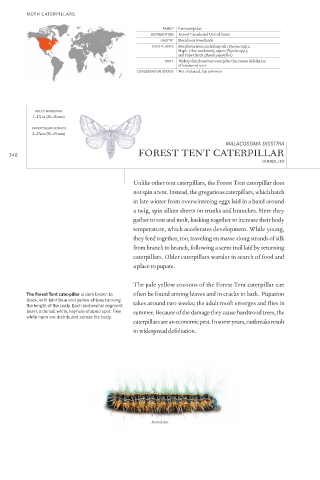
         The Forest Tent caterpillar is dark brown to   often be found among leaves and in cracks in bark. Pupation
         black, with faint blue and yellow stripes running   takes around two weeks; the adult moth emerges and   ies in
         the length of the body. Each abdominal segment
         bears a dorsal, white, keyhole-shaped spot. Fine   summer. Because of the damage they cause hardwood trees, the
         white hairs are distributed across the body.
                                            caterpillars are an economic pest. In some years, outbreaks result
                                            in widespread defoliation.


                                                 Actual size

