


Page 349 - The Book of Caterpillars: A Life-Size Guide to Six Hundred Species From Around the World
P. 349
MOTH CATERPILLARS

                      FAMILY  Lasiocampidae
                  DISTRIBUTION  Across Europe, North Africa, and Asia (except for the far north
                           and south)
                     HABITAT  Salt marsh, marshes, heaths, and woodlands
                  HOST PLANTS  Various, including Cypress Spurge (Euphorbia cyparissias),
                           Golden Samphire (Inula crithmoides), Salad Burnet (Sanguisorba
                           minor), and Common Sea-lavender (Limonium vulgare)
                      NOTE  Gregarious tent caterpillar that spins a silken web
             CONSERVATION STATUS  Not evaluated, and although widespread may be locally scarce


                                                                                   ADULT WINGSPAN
                                                                                  1¼–1⅝ in (31–41 mm)
                                                                                  CATERPILLAR LENGTH
                                                                                  1    –2 in (40–50 mm)
            MALACOSOMA CASTRENSIS
            GROUND LACKEY                                                                        347

            (LINNAEUS, 1758)


            Ground Lackey caterpillars emerge in spring and early summer
            from overwintering eggs laid in a ring around the stem of a host
            plant and  xed so that they remain  rmly in place despite—in


            the case of salt marsh plants—inundations from the sea. The
            caterpillars feed on almost any plant and mass together as they
            forage, leaving a silken trail back to their web. Their long,
            urticating hairs deter predators. Once mature, the caterpillars
            disperse and pupate in grass in a slightly transparent cocoon.


            The moth ecloses and flies in late summer. The Ground
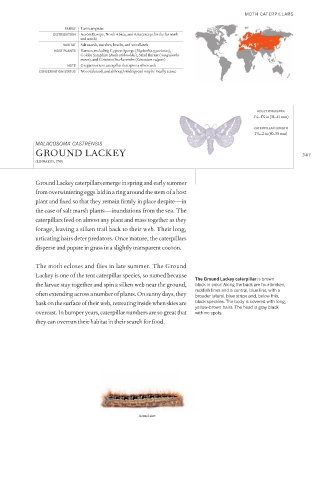
            Lackey is one of the tent caterpillar species, so named because   The Ground Lackey caterpillar is brown
            the larvae stay together and spin a silken web near the ground,   black in color. Along the back are four broken,
            often extending across a number of plants. On sunny days, they   reddish lines and a central, blue line, with a
                                                               broader lateral, blue stripe and, below this,
            bask on the surface of their web, retreating inside when skies are   black speckles. The body is covered with long,
            overcast. In bumper years, caterpillar numbers are so great that   yellow-brown hairs. The head is gray black
                                                               with no spots.
            they can overrun their habitat in their search for food.


                                             Actual size

