


Page 346 - The Book of Caterpillars: A Life-Size Guide to Six Hundred Species From Around the World
P. 346
MOTH CATERPILLARS

                                                     FAMILY  Lasiocampidae
                                                 DISTRIBUTION  Europe, Asia Minor, and east to northeast Asia
                                                    HABITAT  Open places with low scrub, including mountain moorlands,
                                                          lowland acid heathlands, downlands, coastal dunes, woodland
                                                          edges, and hedgerows
                                                  HOST PLANTS  Mainly on shrubs, including Bilberry (Vaccinium myrtillus),
                                                          Heather (Calluna vulgaris), heath (Erica spp.), Bramble (Rubus
                                                          fruticosus), and willow (Salix spp.); also herbaceous plants and
                                                          rushes (Juncus spp)
                                                      NOTE  Furry caterpillar that often basks and feeds in sunshine
                                             CONSERVATION STATUS  Not evaluated, but common throughout most of its range


            ADULT WINGSPAN
           2⅜–3½ in (60–90 mm)
           CATERPILLAR LENGTH
           2 ⁄  –3⅛ in (65–80 mm)
                                                                          LASIOCAMPA QUERCUS
                                                                        OAK EGGAR
    344
                                                                                   (LINNAEUS, 1758)


                                            The life cycle of the Oak Eggar caterpillar varies according to
                                            climate. In warmer regions, the adults  y and mate in July and

                                            August. Eggs are laid and larvae hatch soon after, overwintering
                                            when well developed and pupating the following spring in a
                                            tough, compact acorn-shaped cocoon. In cooler climates, the

                                            adults  y in May and June, and the larvae hatch in July, with

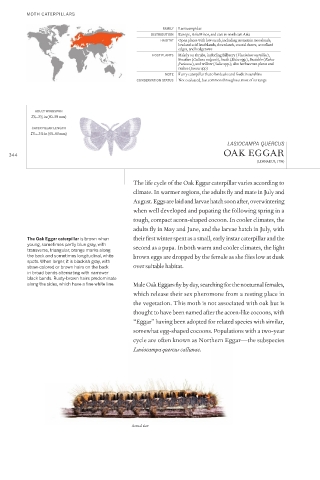
          The Oak Eggar caterpillar is brown when   their  rst winter spent as a small, early instar caterpillar and the
          young, sometimes partly blue gray, with   second as a pupa. In both warm and cooler climates, the light
          transverse, triangular, orange marks along

          the back and sometimes longitudinal, white   brown eggs are dropped by the female as she  ies low at dusk
          spots. When larger, it is blackish gray, with
          straw-colored or brown hairs on the back   over suitable habitat.
          in broad bands alternating with narrower
          black bands. Rusty-brown hairs predominate

          along the sides, which have a   ne white line.   Male Oak Eggars  y by day, searching for the nocturnal females,
                                            which release their sex pheromone from a resting place in
                                            the vegetation. This moth is not associated with oak but is
                                            thought to have been named after the acorn-like cocoons, with
                                            “Eggar” having been adopted for related species with similar,
                                            somewhat egg-shaped cocoons. Populations with a two-year
                                            cycle are often known as Northern Eggar—the subspecies
                                            Lasiocampa quercus callunae.


                                           Actual size

