


Page 352 - The Book of Caterpillars: A Life-Size Guide to Six Hundred Species From Around the World
P. 352
MOTH CATERPILLARS

                                                     FAMILY  Lasiocampidae
                                                 DISTRIBUTION  Europe, Asia Minor, Russia, China, and Japan
                                                    HABITAT  Woodlands, orchards, and forests at low and high elevations
                                                          up to 9,850 ft (3,000 m)
                                                  HOST PLANTS  Plum (Prunus spp.), pear (Pyrus spp.), hawthorn (Crataegus spp.),
                                                          willow (Salix spp.), elm (Ulmus spp.), and oak (Quercus spp.)
                                                      NOTE  Extremely cryptic caterpillar that is sometimes found on fruit trees
                                             CONSERVATION STATUS  Not evaluated


            ADULT WINGSPAN
           1 ⁄  –2⅜ in (30–60 mm)
           CATERPILLAR LENGTH
           1¾–2⅛ in (45–55 mm)
                                                                             ODONESTIS PRUNI
                                                                     PLUM LAPPET
    350
                                                                                   (LINNAEUS, 1758)


                                            Plum Lappet caterpillars hatch in late summer or early fall
                                            from spherical white eggs, laid singly or in small groups on the

                                            leaves of host plants. The larvae develop slowly through  ve
                                            instars and overwinter as mid-instars, completing development
                                            the following spring. In most areas there are two generations,
                                            although there may only be one in northern ranges. The
                                            caterpillars are usually solitary, gaining protection from
                                            remarkable camouflage coloring that renders them hard to
                                            spot on twigs and branches. When mature, they spin a dense
                                            silken cocoon, from which the adult moth emerges within two
                                            to three weeks.


                                            The Odonestis pruni caterpillar has been reported as an economic
                                            pest of fruit trees in parts of Europe, particularly on cherries


                                            and plums, as re ected in the  rst part of the common name.

                                            The second part of the name was inspired by the  aps covering
                                            the caterpillar’s prolegs, like a fold, or “lappet,” in a garment.


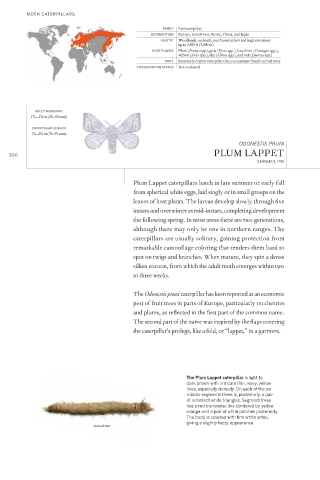
                                                             The Plum Lappet caterpillar is light to
                                                             dark brown with intricate thin, wavy, yellow
                                                             lines, especially dorsally. On each of the six
                                                             middle segments there is, posteriorly, a pair
                                                             of indistinct white triangles. Segment three
                                                             has a red transverse line bordered by yellow
                                                             orange and a pair of white patches posteriorly.
                                                             The body is covered with   ne white setae,
                                                             giving a slightly fuzzy appearance.
                               Actual size

