


Page 351 - The Book of Caterpillars: A Life-Size Guide to Six Hundred Species From Around the World
P. 351
MOTH CATERPILLARS

                      FAMILY  Lasiocampidae
                  DISTRIBUTION  Europe, North Africa, and across Asia (except for the far north
                           and south) to Japan
                     HABITAT  Deciduous forests up to 5,250 ft (1,600 m) elevation,
                           hedgerows, verges, grasslands, and farmlands
                  HOST PLANTS  Deciduous trees, including apple (Malus spp.), hawthorn
                           (Crataegus spp.), willow (Salix spp.), and oak (Quercus spp.)
                      NOTE  Gregarious caterpillar that feeds within a vast silken web
             CONSERVATION STATUS  Not evaluated, but decreasing locally


                                                                                   ADULT WINGSPAN
                                                                                  1–1⅜ in (25–35 mm)
                                                                                  CATERPILLAR LENGTH
                                                                                  1¾–2 in (45–50 mm)
            MALACOSOMA NEUSTRIA
            LACKEY MOTH                                                                          349

            (LINNAEUS, 1758)


            Lackey Moth caterpillars hatch en masse in spring from a ring
            of overwintering eggs laid around twigs. The gregarious
            larvae live together in a silken web, spun across branches of
            the host tree. The web helps them regulate their temperature;
            on sunny days the larvae bask on the surface to raise their body
            temperature so they can become active. It also gives them
            protection and deters natural enemies such as parasitic wasps
            and birds. Mature caterpillars disperse into the surrounding
            vegetation in search of food and a place to pupate.


            The sparse cocoons can be found among leaves under trees
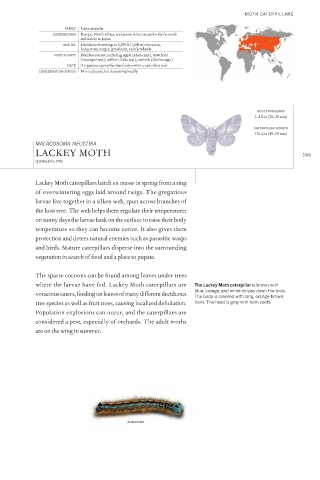
            where the larvae have fed. Lackey Moth caterpillars are   The Lackey Moth caterpillar is brown with

            voracious eaters, feeding on leaves of many di erent deciduous   blue, orange, and white stripes down the back.
                                                               The body is covered with long, orange-brown
            tree species as well as fruit trees, causing localized defoliation.   hairs. The head is gray with dark spots.
            Population explosions can occur, and the caterpillars are
            considered a pest, especially of orchards. The adult moths
            are on the wing in summer.


                                          Actual size

