


Page 345 - The Book of Caterpillars: A Life-Size Guide to Six Hundred Species From Around the World
P. 345
MOTH CATERPILLARS

                      FAMILY  Lasiocampidae
                  DISTRIBUTION  Europe to eastern Siberia, Russian Far East, China, and Japan
                     HABITAT  Forests, woodland edges, scrub, and hedgerows
                  HOST PLANTS  Blackthorn (Prunus spinosa), hawthorn (Crataegus spp.),
                           buckthorn (Rhamnus spp.), oak (Quercus spp.), willow
                           (Salix spp.), and other broadleaved trees

                      NOTE  Large, hairy caterpillar that rests camou aged along a stem
             CONSERVATION STATUS  Not evaluated, but declining in parts of Europe, including
                           the United Kingdom


                                                                                   ADULT WINGSPAN
                                                                                  2⅜–3½ in (60–90 mm)
                                                                                  CATERPILLAR LENGTH
                                                                                  3–3½ in (75–90 mm)
            GASTROPACHA QUERCIFOLIA
            LAPPET                                                                               343

            (LINNAEUS, 1758)


            The Lappet caterpillar hatches in late summer from a white,
            green-marbled, oval egg, laid in small groups attached to twigs.
            It hibernates while still small, uncovered but well concealed on
            or often underneath small stems, low down close to the ground.
            In the spring, the larva ascends the bush to feed at night and is
            fully fed in May or June. The dark gray pupa is formed inside a
            tough, gray-brown cocoon attached low down on the food plant.


            The species’ common name comes from the hairy protuberances,
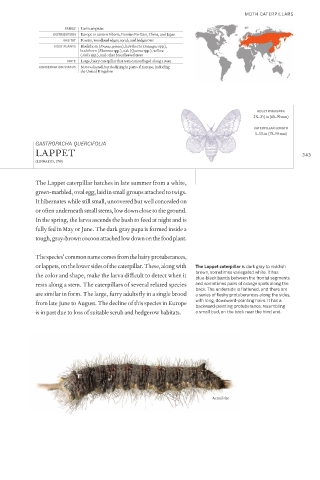
            or lappets, on the lower sides of the caterpillar. These, along with   The Lappet caterpillar is dark gray to reddish


            the color and shape, make the larva di cult to detect when it   brown, sometimes variegated white. It has
                                                               blue-black bands between the frontal segments
            rests along a stem. The caterpillars of several related species   and sometimes pairs of orange spots along the
            are similar in form. The large, furry adults  y in a single brood   back. The underside is   attened, and there are

                                                               a series of   eshy protuberances along the sides,
            from late June to August. The decline of this species in Europe   with long, downward-pointing hairs. It has a
                                                               backward-pointing protuberance, resembling
            is in part due to loss of suitable scrub and hedgerow habitats.   a small bud, on the back near the hind end.


                                                                     Actual size

