


Page 343 - The Book of Caterpillars: A Life-Size Guide to Six Hundred Species From Around the World
P. 343
MOTH CATERPILLARS

                      FAMILY  Lasiocampidae
                  DISTRIBUTION  Across Europe, extending east across Asia to China’s eastern coast
                     HABITAT  Hedgerows
                  HOST PLANTS  Deciduous trees, including Blackthorn (Prunus spinosa), hawthorn
                           (Crataegus spp.), birch (Betula spp.), and willow (Salix spp.)
                      NOTE  Social caterpillar that is covered in tufts of long hairs
             CONSERVATION STATUS  Not evaluated, but numbers are declining


                                                                                   ADULT WINGSPAN
                                                                                  1    –1     in (30–40 mm)
                                                                                  CATERPILLAR LENGTH
                                                                                    2 in (50 mm)
            ERIOGASTER LANESTRIS
            SMALL EGGAR                                                                          341

            (LINNAEUS, 1758)


            Small Eggar caterpillars hatch from eggs laid near the tip
            of branches, and they can be seen from late spring to mid
            summer. The larvae are gregarious, living together in a large,
            tent-shaped, silken web, which they spin between branches of
            a host tree. They leave the web to forage, following trails
            marked by returning caterpillars. On sunny days the caterpillars
            bask on the surface of the web. The largest webs are home to
            hundreds of caterpillars, and their weight can cause the branches
            to bend downward.


            The full-grown caterpillars leave the web and crawl down
            the tree to  nd a place to pupate. They spin a brown cocoon,

            in which they remain for up to a year before emerging. Studies
            have found that some remain in the pupal stage for as long as ten
            years. The adult moths are on the wing in early spring, although
            the females are weak  iers and do not travel far.

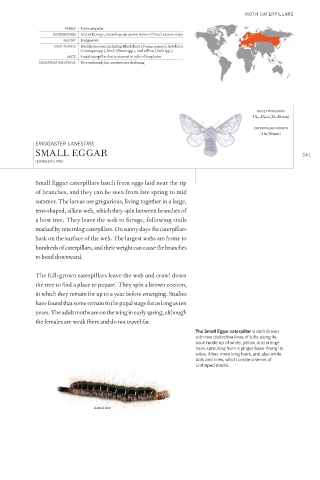
                                                               The Small Eggar caterpillar is dark brown
                                                               with two distinctive lines of tufts along its
                                                               back made up of white, yellow, and orange
                                                               hairs sprouting from a ginger base. Along its
                                                               sides, it has more long hairs, and also white
                                                               dots and lines, which create a series of
                                                               U-shaped marks.


                               Actual size

