


Page 354 - The Book of Caterpillars: A Life-Size Guide to Six Hundred Species From Around the World
P. 354
MOTH CATERPILLARS

                                                     FAMILY  Brahmaeidae
                                                 DISTRIBUTION
                                                 DIS TRIBUTION  Russian Far East, Mongolia, China, and Korean peninsula
                                                 DISTRIBUTION
                                                       A
                                                    HABITAT T  Forests and woodlands
                                                    HABITAT
                                                    HABIT
                                                  HOST PLANTS
                                                  HOST PLANTS
                                                  HOS T PLANT S  Privet (Ligustrum spp.), ash (Fraxinus spp.), and lilac (Syringa spp.)
                                                      NO
                                                      NOTE  Spectacularly tentacled caterpillar
                                                      NOTE
                                                       TE
                                             CONSERVATION STATUS
                                             CONSERV A TION S T A TUS  Not evaluated
                                             CONSERVATION STATUS
            ADULT WINGSPAN
           4⅝–6 in (120–150 mm)
           CATERPILLAR LENGTH
           2¾–3⅛ in (70–80 mm)
                                                                            BRAHMAEA CERTHIA
                                                 SINO-KOREAN OWL MOTH
    352
                                                                                   (FABRICIUS, 1793)


                                            Sino-Korean Owl Moth caterpillars emerge from large, creamy-
                                            white spherical eggs laid in clusters on host plant stems and
                                            trunks some seven to ten days earlier. First instar caterpillars,
                                            already with tentacles, hatch by eating a hole through the
                                            eggshell. The larvae grow rapidly, eating leaves from the edges
                                            and consuming a great amount of vegetation; they take less than
                                            three weeks to complete their development. The caterpillars

                                            are gregarious at  rst but then become solitary. Final instars
                                            lose their tentacles and head toward the ground, where they

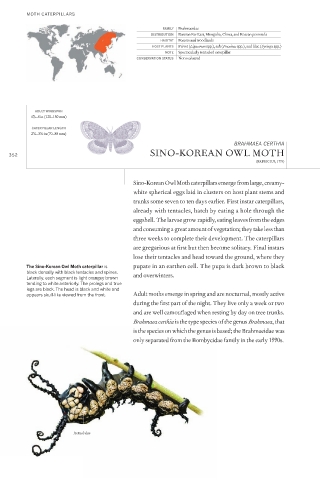
         The Sino-Korean Owl Moth caterpillar is   pupate in an earthen cell. The pupa is dark brown to black
         black dorsally with black tentacles and spines.   and overwinters.
         Laterally, each segment is light orangey brown
         tending to white anteriorly. The prolegs and true
         legs are black. The head is black and white and
         appears skull-like viewed from the front.  Adult moths emerge in spring and are nocturnal, mostly active
                                            during the  rst part of the night. They live only a week or two

                                            and are well camou aged when resting by day on tree trunks.

                                            Brahmaea certhia is the type species of the genus Brahmaea, that
                                            is the species on which the genus is based; the Brahmaeidae was
                                            only separated from the Bombycidae family in the early 1990s.


                        Actual size

