


Page 355 - The Book of Caterpillars: A Life-Size Guide to Six Hundred Species From Around the World
P. 355
MOTH CATERPILLARS

                      FAMILY  Brahmaeidae
                    TRIBUTION
                  DISTRIBUTION  Japan
                  DISTRIBUTION
                  DIS
                     HABIT
                        A
                     HABITAT T  Humid deciduous forests
                     HABITAT
                  HOST PLANTS S  Ash (Fraxinus spp.), privet (Ligustrum spp.), and Osmanthus spp.
                    T PLANT
                  HOST PLANTS
                  HOS
                        TE
                      NOTE
                      NO
                      NOTE  Large, brightly colored caterpillar that is found only in Japan
                       TUS
                  A
                      T
                   TION S
                       A
             CONSERVATION STATUS
             CONSERV
             CONSERVATION STATUS  Not evaluated
                                                                                   ADULT WINGSPAN
                                                                                  3⅛–4½ in (80–115 mm)
                                                                                  CATERPILLAR LENGTH
                                                                                    2¾ in (70 mm)
            BRAHMAEA JAPONICA
            JAPANESE OWL MOTH                                                                    353
            (BUTLER, 1873)
            Japanese Owl Moth caterpillars hatch from smooth, brown,
            dome-shaped eggs laid in small clusters on the leaves of the host
            plant. The young and mature caterpillar look very di erent,

            with the young caterpillar white in color with markings of black

            and yellow and sporting four long, black thoracic  laments and
            three anal filaments. These filaments grow longer with each

            molt but are then replaced by small tubercles in the  nal molt.
            The mature caterpillars move to the ground, where they pupate
            under logs or stones and overwinter. The pupa is black.

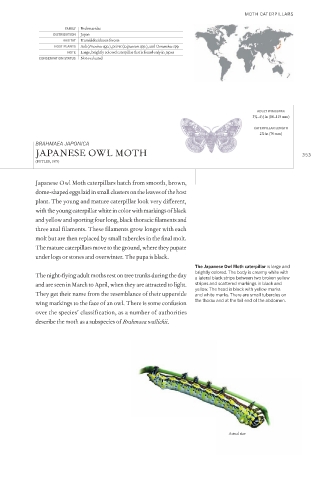
                                                               The Japanese Owl Moth caterpillar is large and
            The night- ying adult moths rest on tree trunks during the day   brightly colored. The body is creamy white with

                                                               a lateral black stripe between two broken yellow
            and are seen in March to April, when they are attracted to light.   stripes and scattered markings in black and
            They get their name from the resemblance of their upperside   yellow. The head is black with yellow marks
                                                               and white marks. There are small tubercles on
            wing markings to the face of an owl. There is some confusion   the thorax and at the tail end of the abdomen.
            over the species’ classification, as a number of authorities
            describe the moth as a subspecies of Brahmaea wallichii.


                                                                          Actual size

