


Page 356 - The Book of Caterpillars: A Life-Size Guide to Six Hundred Species From Around the World
P. 356
MOTH CATERPILLARS

                                                     FAMILY  Brahmaeidae
                                                 DISTRIBUTION  Southern Siberia and Russian Far East, Mongolia, China, Korea,
                                                          and south to Indonesia
                                                    HABITAT  Forests
                                                  HOST PLANTS  Privet (Ligustrum spp.)

                                                      NOTE  Striking caterpillar that displays false eyes to scare o  predators
                                             CONSERVATION STATUS  Not evaluated


            ADULT WINGSPAN
           4–4⅝ in (100–120 mm)
           CATERPILLAR LENGTH
           3½–4 in (90–100 mm)
                                                                            BRAHMAEA TANCREI
                                                         SIBERIAN OWL MOTH
    354
                                                                                    AUSTAUT, 1896


                                            Siberian Owl Moth caterpillars hatch from round, white eggs
                                            laid on the underside of leaves, eating their eggshells before
                                            feeding on the leaves. They have four long, black  laments on

                                            their thorax and a further three at the tail end of their abdomen.

                                            These  laments are lost after the third molt and replaced by false
                                            eyespots on the thorax, which normally remain hidden. The
                                            species does not spin a cocoon but pupates underground or in
                                            the leaf litter, where it overwinters.


                                            The adult moths are on the wing in April, and there is just a
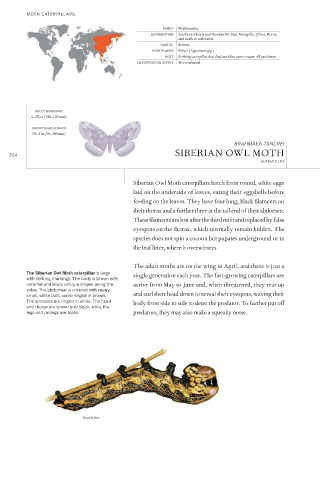
         The Siberian Owl Moth caterpillar is large   single generation each year. The fast-growing caterpillars are
         with striking markings. The body is brown with
         caramel and black oblique stripes along the   active from May to June and, when threatened, they rear up
         sides. The abdomen is covered with many
         small, white dots, some ringed in brown.   and curl their head down to reveal their eyespots, waving their
         The spiracles are ringed in white. The head   body from side to side to deter the predator. To further put o
         and thorax are brown and black, while the
         legs and prolegs are black.        predators, they may also make a squeaky noise.


                           Actual size

