


Page 358 - The Book of Caterpillars: A Life-Size Guide to Six Hundred Species From Around the World
P. 358
MOTH CATERPILLARS

                                                     FAMILY  Brahmaeidae
                                                 DISTRIBUTION  Europe, Asia Minor, and Russia to the Ural Mountains
                                                    HABITAT  Farmlands, orchards, grasslands, wet meadows, and fens
                                                  HOST PLANTS  Yarrow (Achillea spp.), hawkweed (Hieracium spp.),
                                                          and dandelion (Taraxacum spp.)

                                                      NOTE  Hairy caterpillar of a day- ying moth
                                             CONSERVATION STATUS  Not evaluated, but locally vulnerable


            ADULT WINGSPAN
           1¾–2 ⁄   in (45–65 mm)
           CATERPILLAR LENGTH
             1 ⁄   in (40 mm)
                                                                                LEMONIA DUMI
                                                                  LEMONIA DUMI
    356
                                                                                   (LINNAEUS, 1761)


                                            Female Lemonia dumi moths lay their brown eggs in clusters
                                            around the stems of the food plant. The eggs overwinter and the
                                            caterpillars hatch in early summer. The larvae feed on a range of
                                            food plants belonging to the Asteraceae family, including weeds
                                            such as dandelion. After the  nal instar, they move to the ground

                                            to pupate, crawling into underground chambers. The day- ying

                                            moths emerge late in the year, and are seen on warm days in
                                            October and November.


                                            This species has su ered a sharp decline in recent decades due to

                                            loss of its habitat through farm intensi cation, the use of arti cial

                                            fertilizers, land drainage, and the loss of traditional orchards.
                                            The genus Lemonia comprises about 12 species, found in Europe
                                            and temperate parts of Asia. Once considered to be in the family
                                            Lemoniidae, it is now, thanks to recent DNA analysis, placed in

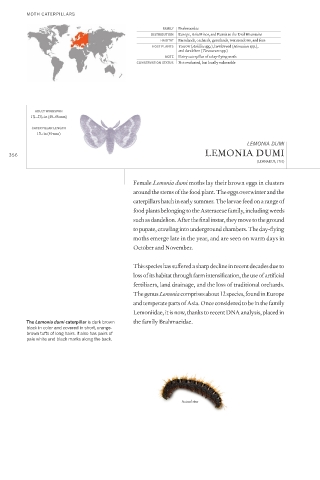
         The Lemonia dumi caterpillar is dark brown   the family Brahmaeidae.
         black in color and covered in short, orange-
         brown tufts of long hairs. It also has pairs of
         pale white and black marks along the back.


                                                           Actual size

