


Page 359 - The Book of Caterpillars: A Life-Size Guide to Six Hundred Species From Around the World
P. 359
MOTH CATERPILLARS

                      FAMILY  Anthelidae
                    TRIBUTION
                  DISTRIBUTION  East coast of Australia, Tasmania
                  DIS
                  DISTRIBUTION
                     HABITAT
                        A
                     HABITAT T  Woodlands, scrub, and coastal scrub
                     HABIT
                  HOST PLANTS S  Wattle (Acacia spp.)
                    T PLANT
                  HOS
                  HOST PLANTS
                      NO
                        TE
                      NOTE  Slender and hairy caterpillar that has stinging hairs
                      NOTE
                  A
                      T
                       TUS
                   TION S
                       A
             CONSERVATION STATUS
             CONSERVATION STATUS  Not evaluated
             CONSERV
                                                                                   ADULT WINGSPAN
                                                                                  1 ⁄  –1 ⁄   in (30–40 mm)
                                                                                  CATERPILLAR LENGTH
                                                                                    2 in (50 mm)
            NATAXA FLAVESCENS
            YELLOW-HEADED ANTHELID                                                               357
            (WALKER, 1855)
            The female Yellow-headed Anthelid moth lays her creamy,
            round eggs in a line along the edge of a leaf or stem of the host
            plant. The eggs overwinter, and the caterpillars hatch in spring.
            The fast-moving larva is often found on the trunk of the host
            plant, and its hairs can irritate if a person or a predator picks
            it up. The mature caterpillar spins a cocoon that it positions
            in a crevice or under bark, and the adult moth ecloses a
            few weeks later.


            Yellow-headed Anthelid moths are nocturnal and attracted to
            light, and are on the wing in late summer and fall. The sexes look
            very di erent—the female is larger with dark gray and white

            wings, and the male is smaller with orange, brown,
            and cream wings. Anthelidae is a family of lappet moths found
            only in Australia and New Guinea. There are 74 named species,
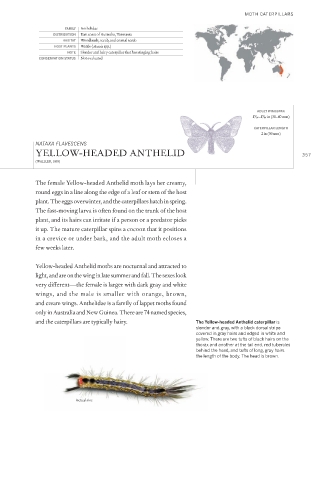
            and the caterpillars are typically hairy.           The Yellow-headed Anthelid caterpillar is
                                                                slender and gray, with a black dorsal stripe
                                                                covered in gray hairs and edged in white and
                                                                yellow. There are two tufts of black hairs on the
                                                                thorax and another at the tail end, red tubercles
                                                                behind the head, and tufts of long, gray hairs
                                                                the length of the body. The head is brown.


                         Actual size

