


Page 360 - The Book of Caterpillars: A Life-Size Guide to Six Hundred Species From Around the World
P. 360
MOTH CATERPILLARS

                                                     FAMILY  Endromidae
                                                 DISTRIBUTION  United Kingdom (only Scottish Highlands and possibly
                                                          Worcestershire), Europe, across Asia to Siberia and
                                                          northern China
                                                    HABITAT  Deciduous woodlands dominated by birch (Betula spp.),
                                                          coppiced woodlands, moorlands, and bog edge woodlands
                                                  HOST PLANTS  Deciduous trees, including alder (Alnus spp.), birch (Betula spp.),
                                                          hazel (Corylus spp.), and European Hornbeam (Carpinus betulus)
                                                      NOTE  Species with a pupal period lasting up to three years
                                             CONSERVATION STATUS  Not evaluated, but scarce in parts of its range


            ADULT WINGSPAN
            2–2¾ in (50–70mm)
           CATERPILLAR LENGTH
             2 in (50 mm)
                                                                        ENDROMIS VERSICOLORA
                                                                 KENTISH GLORY
    358
                                                                                   (LINNAEUS, 1758)


                                            Kentish Glory females lay up to 250 yellow-brown eggs in rows
                                            on thin branches of the host trees. The caterpillars, initially
                                            colored black, hatch 10 to 14 days later and stay together at  rst

                                            in groups of up to 30. Later, they move apart and feed alone at

                                            night, descending to the ground after the  nal molt to pupate,
                                            spinning a cocoon about an inch deep in moss. They may remain
                                            in the cocoon for up to three years before emerging as adults.


                                            The day-flying adults are among the earliest moths to be
                                            on the wing, emerging in late winter. Named for the English
                                            county of Kent, where it was once abundant, the increasingly
                                            scarce Kentish Glory moth is no longer found in England—
                                            except possibly for an isolated community in the county of
                                            Worcestershire—and is declining across the rest of its range.
                                            This reduction in numbers is due primarily to habitat loss, as the

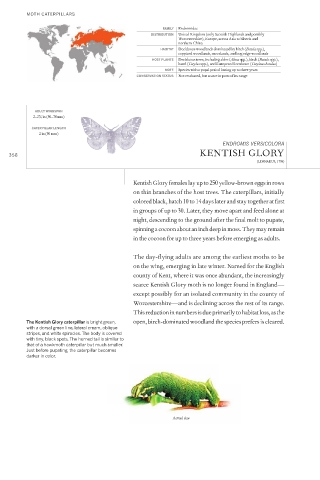
         The Kentish Glory caterpillar is bright green,   open, birch-dominated woodland the species prefers is cleared.
         with a dorsal green line, lateral cream, oblique
         stripes, and white spiracles. The body is covered
         with tiny, black spots. The horned tail is similar to
         that of a hawkmoth caterpillar but much smaller.
         Just before pupating, the caterpillar becomes
         darker in color.


                                                        Actual size

