


Page 361 - The Book of Caterpillars: A Life-Size Guide to Six Hundred Species From Around the World
P. 361
MOTH CATERPILLARS

                      FAMILY  Bombycidae
                  DISTRIBUTION  No longer found in the wild, but now bred worldwide;
                           historically, north India, China, Korea, and Japan
                     HABITAT  Historically, woodlands and parks
                  HOST PLANTS  Mulberry (Morus spp.), especially White Mulberry (Morus alba)
                      NOTE  Renowned caterpillar bred for its cocoon’s extensive
                           silken thread
             CONSERVATION STATUS  Not evaluated as commonly bred


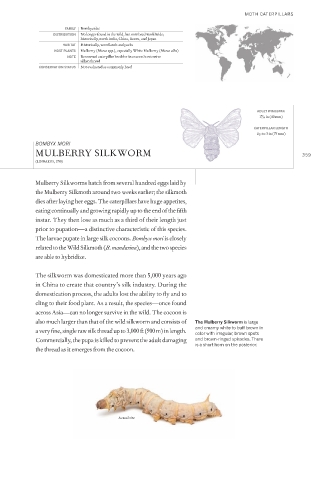
                                                                                   ADULT WINGSPAN
                                                                                    1 ⁄   in (40 mm)
                                                                                  CATERPILLAR LENGTH
                                                                                   Up to 3 in (75 mm)
            BOMBYX MORI
            MULBERRY SILKWORM                                                                    359

            (LINNAEUS, 1758)


            Mulberry Silkworms hatch from several hundred eggs laid by
            the Mulberry Silkmoth around two weeks earlier; the silkmoth
            dies after laying her eggs. The caterpillars have huge appetites,

            eating continually and growing rapidly up to the end of the  fth
            instar. They then lose as much as a third of their length just
            prior to pupation—a distinctive characteristic of this species.
            The larvae pupate in large silk cocoons. Bombyx mori is closely
            related to the Wild Silkmoth (B. mandarina), and the two species
            are able to hybridize.


            The silkworm was domesticated more than 5,000 years ago
            in China to create that country’s silk industry. During the
            domestication process, the adults lost the ability to  y and to

            cling to their food plant. As a result, the species—once found
            across Asia—can no longer survive in the wild. The cocoon is
            also much larger than that of the wild silkworm and consists of   The Mulberry Silkworm is large
            a very  ne, single raw silk thread up to 3,000 ft (900 m) in length.   and creamy white to bu   brown in

                                                               color with irregular, brown spots
            Commercially, the pupa is killed to prevent the adult damaging   and brown-ringed spiracles. There
            the thread as it emerges from the cocoon.          is a short horn on the posterior.


                                       Actual size

