


Page 362 - The Book of Caterpillars: A Life-Size Guide to Six Hundred Species From Around the World
P. 362
MOTH CATERPILLARS

                                                     FAMILY  Saturniidae
                                                 DISTRIBUTION  Southeastern Canada and eastern United States,
                                                          south to central Florida
                                                    HABITAT  Deciduous and mixed wood forests and woodlands
                                                  HOST PLANTS  Birch (Betula spp.), alder (Alnus spp.), persimmon (Diospyros

                                                          spp.), Sweetgum, (Liquidambar styraci uar), hickory (Carya spp.),
                                                          and walnut (Juglans spp.)
                                                      NOTE  Cryptic caterpillar that can strip a branch in a day
                                             CONSERVATION STATUS  Not evaluated, but common


            ADULT WINGSPAN
           3–4⅛ in (75–105 mm)
           CATERPILLAR LENGTH
            3–4 in (75–100 mm)
                                                                                  ACTIAS LUNA
                                                                        LUNA MOTH
    360
                                                                                   (LINNAEUS, 1758)


                                            Luna Moth caterpillars feed in groups during the  rst two to
                                            three instars and are solitary thereafter. The amount of food
                                            consumed grows exponentially; by the last instar, a caterpillar

                                            can defoliate a branch in a day. There are  ve instars, and each
                                            instar takes five to seven days to complete. At maturity, the
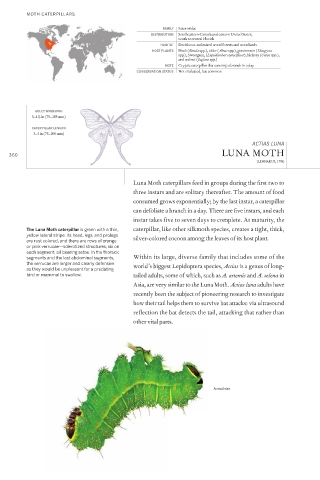
         The Luna Moth caterpillar is green with a thin,   caterpillar, like other silkmoth species, creates a tight, thick,
         yellow lateral stripe. Its head, legs, and prolegs   silver-colored cocoon among the leaves of its host plant.
         are rust colored, and there are rows of orange
         or pink verrucae—sclerotized structures, six on
         each segment, all bearing setae. In the thoracic
         segments and the last abdominal segments,   Within its large, diverse family that includes some of the
         the verrucae are larger and clearly defensive   world’s biggest Lepidoptera species, Actias is a genus of long-
         as they would be unpleasant for a predating
         bird or mammal to swallow.         tailed adults, some of which, such as A. artemis and A. selena in
                                            Asia, are very similar to the Luna Moth. Actias luna adults have
                                            recently been the subject of pioneering research to investigate
                                            how their tail helps them to survive bat attacks: via ultrasound
                                            reflection the bat detects the tail, attacking that rather than
                                            other vital parts.


                                                                     Actual size

