


Page 363 - The Book of Caterpillars: A Life-Size Guide to Six Hundred Species From Around the World
P. 363
MOTH CATERPILLARS

                      FAMILY  Saturniidae
                  DISTRIBUTION  Eastern Africa, from Ethiopia south to KwaZulu-Natal
                           (South Africa)
                     HABITAT  Tropical forests and savannahs
                  HOST PLANTS  Commihora spp., walnut (Juglans spp.), Sclerocarya spp.,
                           and Spirostachys spp.
                      NOTE  Plump caterpillar that is often collected for human consumption
             CONSERVATION STATUS  Not evaluated


                                                                                   ADULT WINGSPAN
                                                                                    4⅝ in (120 mm)
                                                                                  CATERPILLAR LENGTH
                                                                                    3⅛ in (80 mm)
            ACTIAS MIMOSAE
            AFRICAN MOON MOTH                                                                    361

            (BOISDUVAL, 1847)


            The African Moon Moth caterpillar usually hatches with two
            or three siblings but is completely independent of them. As it
            develops through its five instars it becomes very plump and

             rm, and as with many other large African moth species, this
            caterpillar is regularly collected for human consumption. When

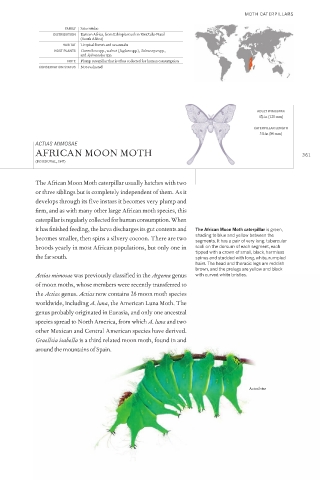
            it has  nished feeding, the larva discharges its gut contents and   The African Moon Moth caterpillar is green,
            becomes smaller, then spins a silvery cocoon. There are two   shading to blue and yellow between the
                                                               segments. It has a pair of very long, tubercular
            broods yearly in most African populations, but only one in   scoli on the dorsum of each segment, each
            the far south.                                     tipped with a crown of small, black, harmless
                                                               spines and studded with long, white, rumpled
                                                               hairs. The head and thoracic legs are reddish
                                                               brown, and the prolegs are yellow and black

            Actias mimosae was previously classi ed in the Argema genus   with curved white bristles.
            of moon moths, whose members were recently transferred to
            the Actias genus. Actias now contains 26 moon moth species
            worldwide, including A. luna, the American Luna Moth. The
            genus probably originated in Eurasia, and only one ancestral
            species spread to North America, from which A. luna and two
            other Mexican and Central American species have derived.
            Graellsia isabella is a third related moon moth, found in and
            around the mountains of Spain.


                                                                                 Actual size

