


Page 364 - The Book of Caterpillars: A Life-Size Guide to Six Hundred Species From Around the World
P. 364
MOTH CATERPILLARS

                                                     FAMILY  Saturniidae
                                                 DISTRIBUTION  South Asia, China, Japan, and parts of Southeast Asia
                                                    HABITAT  Temperate forests, scrub, and gardens
                                                  HOST PLANTS  Various, including Hibiscus spp., apple (Malus spp.), and wild pear
                                                          (Pyrus spp.)
                                                      NOTE  Apple-green silkmoth caterpillar that “clicks” to scare predators
                                             CONSERVATION STATUS  Not evaluated, but widespread


            ADULT WINGSPAN
           3⅛–4⅝ in (80–120 mm)
           CATERPILLAR LENGTH
             4 in (100 mm)
                                                                                ACTIAS SELENE
                                                         INDIAN MOON MOTH
    362
                                                                                    (HÜBNER, 1806)


                                            Indian Moon Moth caterpillars emerge from around 100 pale
                                            brown eggs laid some two weeks earlier on the host plant. The
                                            larvae have an incredibly strong grip, attaching themselves
                                             rmly to branches, which makes it di cult for predators, such


                                            as birds, to pull them o . If disturbed, they defend themselves
                                            by twisting around and making a clicking noise with their jaws
                                            to scare their attackers. As the caterpillar approaches pupation,
                                            it becomes paler in color and spins a silk cocoon in which to
                                            pupate. The adult emerges about six weeks later.

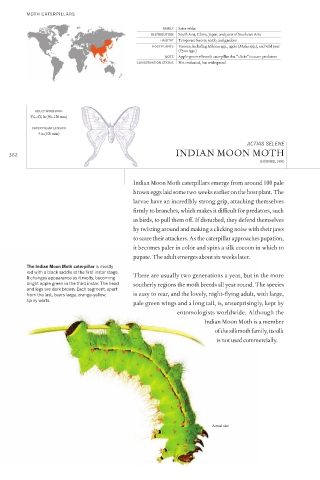
          The Indian Moon Moth caterpillar is mostly
          red with a black saddle at the   rst instar stage.   There are usually two generations a year, but in the more
          It changes appearance as it molts, becoming
          bright apple green in the third instar. The head   southerly regions the moth breeds all year round. The species
          and legs are dark brown. Each segment, apart

          from the last, bears large, orange-yellow,   is easy to rear, and the lovely, night- ying adult, with large,
          spiny warts.                      pale green wings and a long tail, is, unsurprisingly, kept by
                                                          entomologists worldwide. Although the
                                                                  Indian Moon Moth is a member
                                                                      of the silkmoth family, its silk
                                                                      is not used commercially.


                                                                     Actual size

