


Page 366 - The Book of Caterpillars: A Life-Size Guide to Six Hundred Species From Around the World
P. 366
MOTH CATERPILLARS

                                                     FAMILY  Saturniidae
                                                 DISTRIBUTION  North America, from Arizona, Colorado, New Mexico,
                                                          and west Texas to Mexico
                                                    HABITAT  Oak woodlands

                                                  HOST PLANTS  Co ee Berry (Rhamnus californica) and willow (Salix spp.)
                                                      NOTE  Caterpillar of a species that is distinctive within its genus
                                             CONSERVATION STATUS  Not evaluated, but common within its range


            ADULT WINGSPAN
          2  ⁄  –3  ⁄   in (74–94 mm)
           CATERPILLAR LENGTH
           2 ⁄  –2 ⁄   in (55–65 mm)                                      AGAPEMA HOMOGENA
                                                            ROCKY MOUNTAIN
                                                                            AGAPEMA
    364
                                                                                      DYAR, 1908


                                            The Rocky Mountain Agapema caterpillar hatches from a cluster
                                            of 45 to160 ivory-colored, oval eggs in the summer. Initially, it is
                                            all black with white hairs but in the second and remaining instars
                                            it becomes black and yellow. It is gregarious until the fourth and

                                             nal instar, when it becomes solitary. The mature caterpillar
                                            leaves the host plant and spins a  u y, tan-colored cocoon in


                                            a crevice of rock or tree trunk in the fall, and the pupa spends
                                            the winter often covered by snow.

                                            There are seven species of Agapema in the western United States
                                            and Mexico. All are similar as caterpillars and adults, except the
                                            Rocky Mountain Agapema, which is larger, more attractive, and
                                            lives in a forested environment at a higher altitude. The other six
                                            are desert species. Many of the larvae are parasitized by tachinid
                                            flies, which lay their eggs on the leaves that the caterpillars
                                            feed on, eventually killing a larva after it has made a cocoon.
                                Actual size


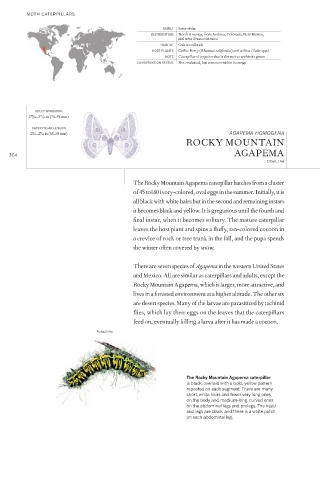
                                                             The Rocky Mountain Agapema caterpillar
                                                             is black, overlaid with a bold, yellow pattern
                                                             repeated on each segment. There are many
                                                             short, white hairs and fewer very long ones
                                                             on the body and medium-long, curved ones
                                                             on the abdominal legs and prolegs. The head
                                                             and legs are black, and there is a white patch
                                                             on each abdominal leg.

