


Page 367 - The Book of Caterpillars: A Life-Size Guide to Six Hundred Species From Around the World
P. 367
MOTH CATERPILLARS

                      FAMILY  Saturniidae
                  DISTRIBUTION  Across Europe and Asia, excluding southern Asia
                     HABITAT  Beech forests, mixed conifer-deciduous forests, and among
                           deciduous trees along rivers within otherwise coniferous forests
                  HOST PLANTS  European Beech (Fagus sylvatica), birch (Betula spp.), Alder
                           (Alnus glutinosa), Goat Willow (Salix caprea), Mountain Ash
                           (Sorbus aucuparia), and oak (Quercus spp.)
                      NOTE  Caterpillar with striped projections when young but
                           cryptic when mature
             CONSERVATION STATUS  Not evaluated, but common


                                                                                   ADULT WINGSPAN
                                                                                  2⅜–3 ⁄   (60–84 mm)
                                                                                  CATERPILLAR LENGTH
                                                                                    2⅜ in (60 mm)
            AGLIA TAU
            TAU EMPEROR                                                                          365

            (LINNAEUS, 1758)


            Tau Emperor caterpillars hatch from eggs that the female
            moth lays at di erent strata of the forest, dispersing them by

            night in small clusters on the leaves and shoots of host trees.
            While in the early instars, the green caterpillars have several
            long, red-and-white dorsal projections that probably protect
            them to some extent from being swallowed by birds; the later
            instars are cryptic. The larvae have only four instars under good
            conditions but will molt into additional instars if conditions are
            not optimal. There is a single generation per year, and the pupa
            overwinters inside a cocoon.


            Tau Emperor males  y fast and erratically when the sun is out
            in early spring, looking for freshly emerged females, which are,
            unlike males, nocturnal. Mating occurs during the day, when
            males, using pheromone trails and visual cues, find a newly
            eclosed female still sitting near her cocoon. Currently, four
            species in the genus Aglia are recognized, all of which are quite   Actual size
            similar. Aglia tau has by far the widest distribution.


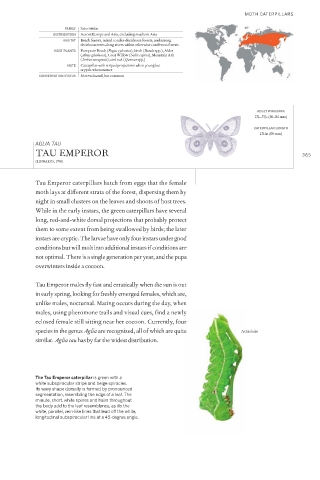
            The Tau Emperor caterpillar is green with a
            white subspiracular stripe and beige spiracles.
            Its wavy shape dorsally is formed by pronounced
            segmentation, resembling the edge of a leaf. The
            minute, short, white spines and hairs throughout
            the body add to the leaf resemblance, as do the
            white, parallel, vein-like lines that lead o   the white,
            longitudinal subspiracular line at a 45-degree angle.

