


Page 368 - The Book of Caterpillars: A Life-Size Guide to Six Hundred Species From Around the World
P. 368
MOTH CATERPILLARS

                                                     FAMILY  Saturniidae
                                                   TRIBUTION
                                                 DISTRIBUTION
                                                 DISTRIBUTION  Central and eastern North America
                                                 DIS
                                                    HABIT
                                                    HABITAT T  Deciduous forests
                                                    HABITAT
                                                       A
                                                  HOST PLANTS
                                                  HOST PLANTS
                                                  HOS T PLANT S  Deciduous hardwood trees, in particular oak (Quercus spp.)
                                                      NOTE
                                                      NO TE  Gregarious, defoliating caterpillar active in late summer
                                                      NOTE
                                                          and fall
                                             CONSERV
                                             CONSERVATION STATUS
                                             CONSERVATION STATUS  Not evaluated, but among the more common in its family
                                                     T
                                                  TION S
                                                      A
                                                      TUS
                                                 A
            ADULT WINGSPAN
           1
   –2 in (30–50 mm)
           CATERPILLAR LENGTH
             2 in (50 mm)                                                   ANISOTA SENATORIA
                                                              ORANGE-STRIPED
                                                                          OAKWORM
    366
                                                                                   (J. E. SMITH, 1797)
                                            Orange-striped Oakworms hatch from eggs laid 10 to 14 days
                                            earlier in large clusters of up to 500 eggs on the underside of
                                            leaves. The dark green young larvae are gregarious but disperse
                                            when they are older. The mature caterpillars tend to eat the entire
                                            leaf except for the midrib. They then drop to the forest  oor and

                                            wander in search of suitable pupation sites underground. They
                                            overwinter as pupae. There is one generation a year, with the
                                            emerging orange-yellow moths active in early to mid summer.

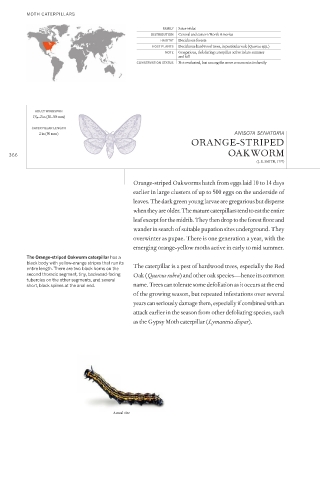
          The Orange-striped Oakworm caterpillar has a
          black body with yellow-orange stripes that run its   The caterpillar is a pest of hardwood trees, especially the Red
          entire length. There are two black horns on the
          second thoracic segment, tiny, backward-facing   Oak (Quercus rubra) and other oak species—hence its common
          tubercles on the other segments, and several
          short, black spines at the anal end.   name. Trees can tolerate some defoliation as it occurs at the end
                                            of the growing season, but repeated infestations over several
                                            years can seriously damage them, especially if combined with an
                                            attack earlier in the season from other defoliating species, such
                                            as the Gypsy Moth caterpillar (Lymantria dispar).


                                     Actual size

