


Page 369 - The Book of Caterpillars: A Life-Size Guide to Six Hundred Species From Around the World
P. 369
MOTH CATERPILLARS

                      FAMILY  Saturniidae
                  DISTRIBUTION  From southern Canada (southeast Ontario to Nova Scotia), south
                           through United States to Florida, and west to Texas and Iowa
                     HABITAT  Deciduous forests and leafy suburbs
                  HOST PLANTS  Oak ( uercus spp.)
                      NOTE  Cryptically colored caterpillar that has two distinctive, black,
                           thoracic projections
             CONSERVATION STATUS  Not evaluated, but common, although in sharp decline


                                                                                   ADULT WINGSPAN
                                                                                  1⅝–2⅝ in (42–66 mm)
                                                                                  CATERPILLAR LENGTH
                                                                                  1 ⁄  –2⅜ in (40–60 mm)
            ANISOTA VIRGINIENSIS
            PINK-STRIPED OAKWORM                                                                 367

            (DRURY, 1773)


            The Pink-striped Oakworm hatches from clutches of round,
            yellow eggs laid on oak leaves. The caterpillars are gregarious
            in the early instars, skeletonizing leaves of their host. Later
            instars are solitary and consume the entire leaf, except for
            the middle vein. The larvae descend to the ground to pupate
            in shallow burrows, and the pupae overwinter. There is one
            brood in the north of the species’ range and two or more in the
            south. While Anisota virginiensis does not normally become a
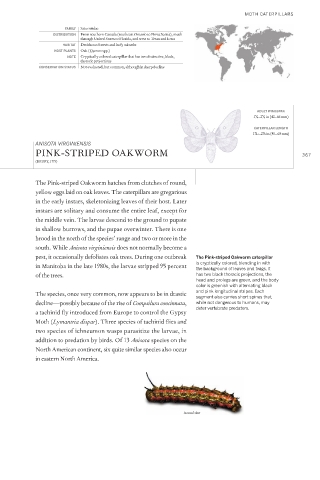
            pest, it occasionally defoliates oak trees. During one outbreak   The Pink-striped Oakworm caterpillar
            in Manitoba in the late 1980s, the larvae stripped 95 percent   is cryptically colored, blending in with
                                                                the background of leaves and twigs. It
            of the trees.                                       has two black thoracic projections, the
                                                                head and prolegs are green, and the body
                                                                color is greenish with alternating black
            The species, once very common, now appears to be in drastic   and pink longitudinal stripes. Each
                                                                segment also carries short spines that,
            decline—possibly because of the rise of Compsilura concinnata,   while not dangerous to humans, may
            a tachinid fly introduced from Europe to control the Gypsy   deter vertebrate predators.
            Moth (Lymantria dispar). Three species of tachinid   ies and
            two species of ichneumon wasps parasitize the larvae, in
            addition to predation by birds. Of 13 Anisota species on the
            North American continent, six quite similar species also occur
            in eastern North America.


                                                            Actual size

