


Page 390 - The Book of Caterpillars: A Life-Size Guide to Six Hundred Species From Around the World
P. 390
MOTH CATERPILLARS

                                                     FAMILY  Saturniidae
                                                 DISTRIBUTION
                                                 DIS TRIBUTION  Mountains of western United States and northwestern Mexico
                                                 DISTRIBUTION
                                                    HABITAT
                                                    HABIT A T  Pine forests
                                                    HABITAT
                                                  HOST PLANTS
                                                  HOST PLANTS
                                                  HOS T PLANT S  Various species of pine (Pinus spp.)
                                                      NOTE
                                                      NOTE  Periodic edible silkmoth caterpillar
                                                       TE
                                                      NO

                                             CONSERVATION STATUS
                                             CONSERV
                                             CONSERVATION STATUS  Not evaluated, but sometimes proli c enough to cause
                                                  TION S
                                                      A
                                                     T
                                                      TUS
                                                 A
                                                          signi cant defoliation

            ADULT WINGSPAN
           2¾–3⅞ in (70–98 mm)
           CATERPILLAR LENGTH
             2     in (65 mm)
                                                                           COLORADIA PANDORA
                                                        PANDORA PINE MOTH
    388
                                                                                      BLAKE, 1863

                                            The Pandora Pine Moth caterpillar has a life cycle of two to  ve
                                            years. It hatches and feeds in the fall, becomes lethargic during
                                            the winter, then feeds again until late June, when it descends
                                            from the tree and burrows into the ground to pupate. It usually
                                            remains there at least through the next winter, and sometimes
                                            up to five years, before emerging as an adult during the
                                            summer to reproduce. Adults are more commonly present
                                            in alternating years, when they sometimes cause extensive
                                            defoliation of pine trees.


                                            The caterpillar of the Pandora Pine Moth is an important
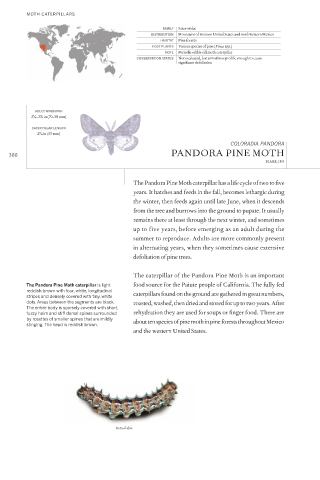
         The Pandora Pine Moth caterpillar is light   food source for the Paiute people of California. The fully fed
         reddish brown with four, white, longitudinal   caterpillars found on the ground are gathered in great numbers,
         stripes and densely covered with tiny, white
         dots. Areas between the segments are black.   roasted, washed, then dried and stored for up to two years. After
         The entire body is sparsely covered with short,

         fuzzy hairs and sti   dorsal spines surrounded   rehydration they are used for soups or  nger food. There are
         by rosettes of smaller spines that are mildly   about ten species of pine moth in pine forests throughout Mexico
         stinging. The head is reddish brown.
                                            and the western United States.


                                      Actual size

