


Page 405 - The Book of Caterpillars: A Life-Size Guide to Six Hundred Species From Around the World
P. 405
MOTH CATERPILLARS

                      FAMILY  Saturniidae
                  DISTRIBUTION  Southern Mexico to eastern Peru, Bolivia,
                           and Brazil (Pará Province)
                     HABITAT  Tropical forests or scrub
                  HOST PLANTS  Unknown in the wild; in captivity has fed on acacia (Acacia spp.)
                      NOTE  Stinging caterpillar that develops through six or seven instars
             CONSERVATION STATUS  Not evaluated, but widespread in tropical America


                                                                                   ADULT WINGSPAN
                                                                                 4⅛–5¼ in (105–135 mm)
                                                                                  CATERPILLAR LENGTH
                                                                                    4 in (100 mm)
            HYPERCHIRIA NAUSICA
            HYPERCHIRIA NAUSICA                                                                  403

            (CRAMER, 1779)


            In its early stages, the Hyperchiria nausica caterpillar is a bright
            yellow member of a tightly knit group and does not acquire
            the caramel color of a mature caterpillar until the sixth and
            seventh instars. When roaming from one leaf or branch to
            another, larvae proceed slowly and deliberately in single  le.

            This caterpillar belongs to the subfamily Hemileucinae, whose
            members generally require six instars for males and seven instars
            for the larger females to mature. Most of the tropical species
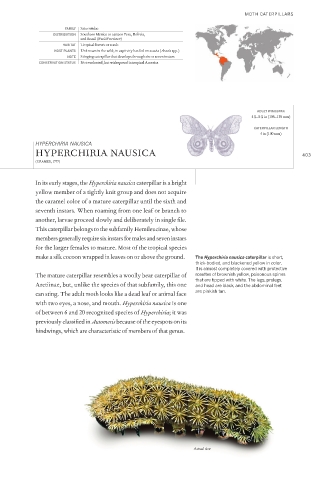
            make a silk cocoon wrapped in leaves on or above the ground.  The Hyperchiria nausica caterpillar is short,
                                                               thick-bodied, and blackened yellow in color.
                                                               It is almost completely covered with protective
            The mature caterpillar resembles a woolly bear caterpillar of   rosettes of brownish yellow, poisonous spines
            Arctiinae, but, unlike the species of that subfamily, this one   that are tipped with white. The legs, prolegs,
                                                               and head are black, and the abdominal feet
            can sting. The adult moth looks like a dead leaf or animal face   are pinkish tan.
            with two eyes, a nose, and mouth. Hyperchiria nausica is one
            of between 6 and 20 recognized species of Hyperchiria; it was
            previously classi ed in Automeris because of the eyespots on its

            hindwings, which are characteristic of members of that genus.


                                                               Actual size

