


Page 402 - The Book of Caterpillars: A Life-Size Guide to Six Hundred Species From Around the World
P. 402
MOTH CATERPILLARS

                                                     FAMILY  Saturniidae
                                                 DISTRIBUTION  Areas of southwestern Canada and western United States,
                                                          south to Baja California
                                                    HABITAT  Wide variation, including redwood and pine forests,
                                                          and riparian areas
                                                  HOST PLANTS  Many, including mountain lilac (Ceanothus spp.), mountain
                                                          mahogany (Cercocarpus spp.), Bitter Cherry (Prunus emarginata),
                                                          and bitterbrush (Purshia spp.)
                                                      NOTE  Gregarious, spiny caterpillar that sometimes defoliates large
                                                          areas of bitterbrush
                                             CONSERVATION STATUS  Not evaluated


            ADULT WINGSPAN
           2 ⁄  –3 ⁄   in (56–87 mm)
           CATERPILLAR LENGTH
             2¾ in (70 mm)
                                                                       HEMILEUCA EGLANTERINA
                                                      ELEGANT SHEEP MOTH
    400
                                                                                  (BOISDUVAL, 1852)


                                            The Elegant Sheep Moth caterpillar hatches in the spring from
                                            a ring of white eggs deposited on a small twig of its host plant
                                            by the adult female during the previous summer or fall. The
                                            caterpillar is black in the  rst instar, but in most populations

                                            it develops a pattern of white or yellow longitudinal stripes
                                            and clusters of variably colored hairs and spines. The young
                                            caterpillars are processional when searching for food and
                                            remain tightly grouped, while more mature caterpillars become
                                            independent. After about six instars, the caterpillar makes a loose
                                            cocoon under leaf litter.


                                            In the United States and Mexico, there are a number of sheep
                                            moth (Hemileuca) species, both diurnal and nocturnal, belonging
                                            to the silkmoth subfamily Hemileucinae, whose caterpillars all
                                            have stinging spines. The Elegant Sheep Moth is diurnal, and
                                            over its range of distribution it displays a wide variety of color
                                            in both caterpillar and adult; in northern and central California,
                                            for instance, the moth can be entirely bright pink.


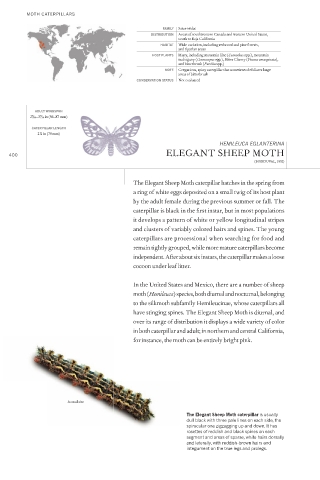
                       Actual size
                                                             The Elegant Sheep Moth caterpillar is usually
                                                             dull black with three pale lines on each side, the
                                                             spiracular one zigzagging up and down. It has
                                                             rosettes of reddish and black spines on each
                                                             segment and areas of sparse, white hairs dorsally
                                                             and laterally, with reddish-brown hairs and
                                                             integument on the true legs and prolegs.

