


Page 403 - The Book of Caterpillars: A Life-Size Guide to Six Hundred Species From Around the World
P. 403
MOTH CATERPILLARS

                      FAMILY  Saturniidae
                    TRIBUTION
                  DISTRIBUTION
                  DISTRIBUTION  Eastern Africa, from KwaZulu-Natal north to Kenya and Uganda
                  DIS
                     HABITAT
                     HABITAT T  Tropical forests and savannahs
                     HABIT
                        A
                  HOS
                  HOST PLANTS
                  HOST PLANTS S  Privet (Ligustrum spp.), jasmine (Jazminium spp.), and Rhus spp.
                    T PLANT

                        TE
                      NOTE  Caterpillars that are polymorphic, taking several di erent forms
                      NOTE
                      NO
             CONSERV A TION S T A TUS  Not evaluated
             CONSERVATION STATUS
             CONSERVATION STATUS
                                                                                   ADULT WINGSPAN
                                                                                  2–3⅜ in (50–85 mm)
                                                                                  CATERPILLAR LENGTH
                                                                                    2⅜ in (60 mm)
            HOLOCERINA SMILAX
            VARIABLE PRINCE SILKMOTH                                                             401
            (WESTWOOD, 1849)


            When the short string of white-and-brown, marbled eggs of
            the Variable Prince Silkmoth begin to hatch, black caterpillars
            crawl out. Each sports two bright brown rectangles on its back
            as it wanders o  to join others of its group on a leaf to feed. After

            the larva molts into its second instar, its color becomes one of
            several variations acquired among its siblings at that time. When
            it has completed only four instars, the caterpillar spins a  imsy

            cocoon of silk and debris above ground, and the adult moth

            emerges about  ve weeks later.

            This silkmoth caterpillar belongs to the African tribe Ludiini
            of the subfamily Saturniinae. Some species of this tribe have
            polymorphic caterpillars, and at least three vastly distinct color
            patterns have been observed in the Variable Prince Silkmoth

             nal instar. The adult moths are also quite dimorphic, with males
            and females having di erently shaped wings and coloration.

            The caterpillars of this and other species of the Ludiini tribe
            possess irritating hairs.


                                                                            Actual size
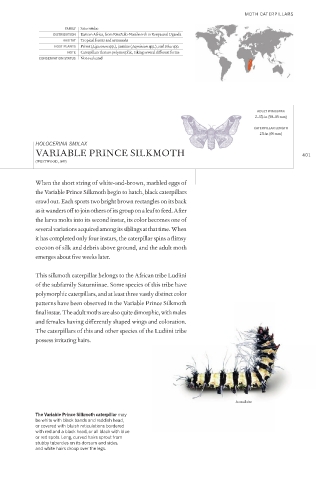
            The Variable Prince Silkmoth caterpillar may
            be white with black bands and reddish head,
            or covered with bluish reticulations bordered
            with red and a black head, or all black with blue
            or red spots. Long, curved hairs sprout from
            stubby tubercles on its dorsum and sides,
            and white hairs droop over the legs.

