


Page 409 - The Book of Caterpillars: A Life-Size Guide to Six Hundred Species From Around the World
P. 409
MOTH CATERPILLARS

                      FAMILY  Saturniidae
                  DISTRIBUTION  Areas of sub-Saharan Africa
                     HABITAT  Tropical forest patches and savannahs
                  HOST PLANTS  Many, including Custard Apple (Anona senegalensis), Psidium spp.,
                           and Sapium spp.
                      NOTE  Large caterpillar collected and eaten in parts of Africa
             CONSERVATION STATUS  Not evaluated


                                                                                   ADULT WINGSPAN
                                                                                  Up to 7 ⁄   in (193 mm)
                                                                                  CATERPILLAR LENGTH
                                                                                    4¼ in (110 mm)
            LOBOBUNAEA PHAEDUSA
            BLOTCHED EMPEROR                                                                     407

            (DRURY, 1782)


            Hatching from a single egg laid separately on the host tree, the
            Blotched Emperor silkmoth caterpillar feeds alone. At the end

            of  ve instars, it moves to the ground to bury itself for pupation.
            If conditions are right, the adult moth may emerge within
            six weeks to produce a second cycle for the year. The larvae used
            to be abundant, but in many areas of Africa these and other large
            moth species are now becoming scarce in the wild as a result of
            overcollecting for food.


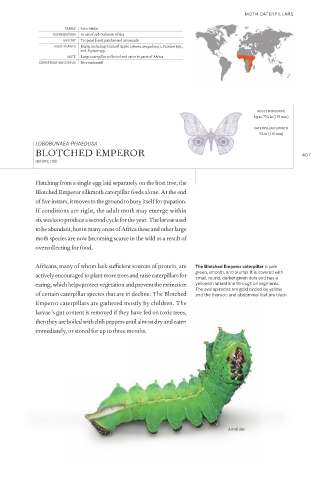
            Africans, many of whom lack su cient sources of protein, are   The Blotched Emperor caterpillar is pale
            actively encouraged to plant more trees and raise caterpillars for   green, smooth, and plump. It is covered with
                                                               small, round, darker green dots and has a
            eating, which helps protect vegetation and prevent the extinction   yellowish lateral line through all segments.
            of certain caterpillar species that are in decline. The Blotched   The oval spiracles are gold circled by yellow,
                                                               and the thoracic and abdominal feet are black.
            Emperor caterpillars are gathered mostly by children. The
            larvae’s gut content is removed if they have fed on toxic trees,
            then they are boiled with chili peppers until almost dry and eaten
            immediately, or stored for up to three months.


                                                                          Actual size

