


Page 400 - The Book of Caterpillars: A Life-Size Guide to Six Hundred Species From Around the World
P. 400
MOTH CATERPILLARS

                                                     FAMILY  Saturniidae
                                                   TRIBUTION
                                                 DIS
                                                 DISTRIBUTION  Southwest Europe
                                                 DISTRIBUTION
                                                    HABITAT
                                                    HABITAT T  Pine forests, at 2,950–5,900 ft (900–1,800 m) elevation
                                                    HABIT
                                                       A
                                                  HOST PLANTS
                                                  HOST PLANTS
                                                  HOS T PLANT S  Pine trees, including Pinus sylvestris, P. laricio, and P. uncinata
                                                      NOTE
                                                      NO TE  Colorful caterpillar that is under threat from habitat loss
                                                      NOTE
                                             CONSERVATION STATUS
                                                     T
                                             CONSERVATION STATUS  Not evaluated, but considered vulnerable
                                             CONSERV
                                                 A
                                                  TION S
                                                      TUS
                                                      A
            ADULT WINGSPAN
           2½–3⅜ in (63–85 mm)
           CATERPILLAR LENGTH
           2¾–3⅛ in (70–80 mm)
                                                                          GRAELLSIA ISABELLAE
                                                        SPANISH MOON MOTH
    398
                                                                                    (GRAËLLS, 1849)
                                            The female Spanish Moon Moth lays up to 150 eggs, either
                                            singly or in small groups at the base of young pine needles. The
                                            caterpillars hatch within ten days and feed on the pine needles,
                                            where they are well disguised. When young, they are gray
                                            brown and resemble the twigs on which they rest, while the
                                            mature caterpillar often rests with its front segments pu ed up

                                            to give the appearance of a pinecone. Growth is slow because
                                            of the cool temperatures, so the caterpillars take up to eight

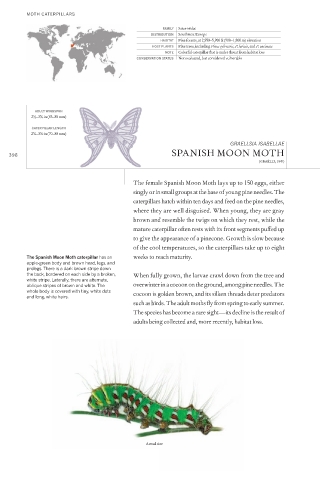
          The Spanish Moon Moth caterpillar has an   weeks to reach maturity.
          apple-green body and brown head, legs, and
          prolegs. There is a dark brown stripe down
          the back, bordered on each side by a broken,   When fully grown, the larvae crawl down from the tree and
          white stripe. Laterally, there are alternate,
          oblique stripes of brown and white. The   overwinter in a cocoon on the ground, among pine needles. The
          whole body is covered with tiny, white dots   cocoon is golden brown, and its silken threads deter predators
          and long, white hairs.
                                            such as birds. The adult moths  y from spring to early summer.

                                            The species has become a rare sight—its decline is the result of
                                            adults being collected and, more recently, habitat loss.


                                                Actual size

