


Page 407 - The Book of Caterpillars: A Life-Size Guide to Six Hundred Species From Around the World
P. 407
MOTH CATERPILLARS


                      FAMILY  Saturniidae
                  DISTRIBUTION  Central America (Costa Rica, Panama, and Guatemala)
                     HABITAT  Medium to upper elevation cloud forests
                  HOST PLANTS  Unknown; in captivity has fed on privet (Ligustrum spp.),
                           ash (Fraxinus spp.), and Laurel Sumac (Malosma laurina)
                      NOTE  Rare, dramatic-looking caterpillar found in tropical
                           cloud forests
             CONSERVATION STATUS  Not evaluated, but likely vulnerable


                                                                                   ADULT WINGSPAN
                                                                                  3½–4 in (90–100 mm)
                                                                                  CATERPILLAR LENGTH
                                                                                  3⅛–3½ in (80–90 mm)
            LEUCANELLA HOSMERA
            LEUCANELLA HOSMERA                                                                   405

            (SCHAUS, 1941)


            Little is known about the striking Leucanella hosmera, which lives
            at high elevations in Central America. The caterpillars hatch
            from shiny green, oval eggs, seemingly laid in clusters or batches
            by female moths, and develop through six instars, with multiple
            generations likely to occur year-round. They march about in
            large groups throughout their development, feeding during
            daylight hours, probably on many di erent kinds of trees and

            bushes, although details of host plants are lacking.


            The larvae advertise themselves with eye-catching, yellow

            and white spines, set o  against a black background, openly
            challenging predators to take a mouthful. Those that are tempted
            discover to their cost something distasteful and likely stinging.
            Pupation takes place within a tough, brown cocoon, probably
            attached to the host trees near the ground. The genus Leucanella
            contains nearly 30 species with similar-looking caterpillars,
            including L. viridescens, a voracious, polyphagous eater that
            can be an economic pest of some crops.


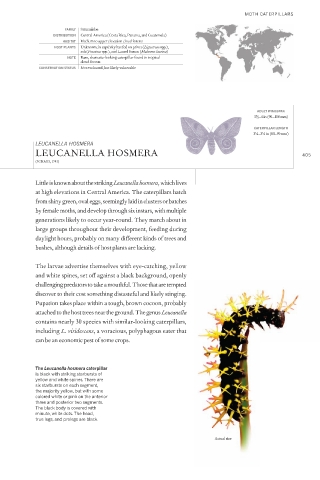
            The Leucanella hosmera caterpillar
            is black with striking starbursts of
            yellow and white spines. There are
            six starbursts on each segment,
            the majority yellow, but with some
            colored white or pink on the anterior
            three and posterior two segments.
            The black body is covered with
            minute, white dots. The head,
            true legs, and prolegs are black.


                                                                      Actual size

