


Page 406 - The Book of Caterpillars: A Life-Size Guide to Six Hundred Species From Around the World
P. 406
MOTH CATERPILLARS

                                                     FAMILY  Saturniidae
                                                 DISTRIBUTION  Eastern Africa, from KwaZulu-Natal north to southern Kenya,
                                                          coastal areas
                                                    HABITAT  Tropical forests and savannahs
                                                  HOST PLANTS  Various, including Castor Bean (Ricinus communis),
                                                          Guava (Psidium guajava), and mango (Mangera spp.)
                                                      NOTE  Caterpillar that is used as food in southern Africa
                                             CONSERVATION STATUS  Not evaluated, but declining in some parts of its range


            ADULT WINGSPAN
          4⅛–5¼ in (105–135 mm)
           CATERPILLAR LENGTH
             4 in (100 mm)                                                IMBRASIA WAHLBERGI
                                                      WAHLBERG’S EMPEROR
                                                                          SILKMOTH
    404
                                                                                   BOISDUVAL, 1847


                                            The Wahlberg’s Emperor Silkmoth begins life as an orange
                                            caterpillar during its  rst instar but, after molting to its second

                                            instar, becomes black with orange bands. It feeds in small
                                            groups during earlier stages but gains greater independence as
                                            it matures. Each instar requires about one week of feeding, and

                                            at the end of the  fth instar the caterpillar stops eating, becomes
                                            discolored, and discharges its gut content. It then burrows into
                                            the ground, where it forms a chamber in which to pupate.


                                            Imbrasia wahlbergi belongs to a tribe, called Bunaeini, of large,
                                            colorful African moths that have a round eyespot on each hind
                                            wing and produce large, non-stinging caterpillars. The larvae,
                                            which are often plentiful, are actively sought for food by several
                                            southern African cultures. Overharvesting has greatly reduced
                                            some populations in certain areas, but, with proper management,
                                            the caterpillars can remain an important food source.


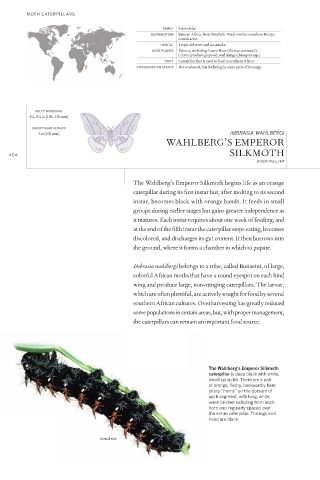
                                                                    The Wahlberg’s Emperor Silkmoth
                                                                    caterpillar is deep black with white,
                                                                    ovoid spiracles. There are a pair
                                                                    of orange,   eshy, backwardly bent
                                                                    sharp “horns” on the dorsum of
                                                                    each segment, with long, white,
                                                                    weak bristles radiating from each
                                                                    horn and regularly spaced over
                                                                    the entire caterpillar. The legs and
                                                                    head are black.


                                 Actual size

