


Page 401 - The Book of Caterpillars: A Life-Size Guide to Six Hundred Species From Around the World
P. 401
MOTH CATERPILLARS

                      FAMILY  Saturniidae
                  DISTRIBUTION  South Africa, from Eastern Cape north to Mozambique
                     HABITAT  Open forests of Mopane (Colophospermum mopane) and
                           Brachystegia spp.
                  HOST PLANTS  Acacia (Acacia spp.)
                      NOTE  Giant silkmoth caterpillar that resembles and mimics small leaves
             CONSERVATION STATUS  Not evaluated


                                                                                   ADULT WINGSPAN
                                                                                  4⅝–5 in (120–130 mm)
                                                                                  CATERPILLAR LENGTH
                                                                                    3¾ in (95 mm)
            GYNANISA MAIA (MAJA)
            SPECKLED EMPEROR                                                                     399

            (KLUG, 1836)


            The Speckled Emperor caterpillar hatches among a small group
            of semiround eggs marbled brown and white. Initially black
            with a tan lateral stripe and black head, it becomes green after
            molting to the second instar. During its  ve instars, the larva

            develops long, silver spikes on its dorsum, which serve to break
            up its green appearance as it feeds on the tiny compound lea ets


            of the acacia tree, making it di cult to see.
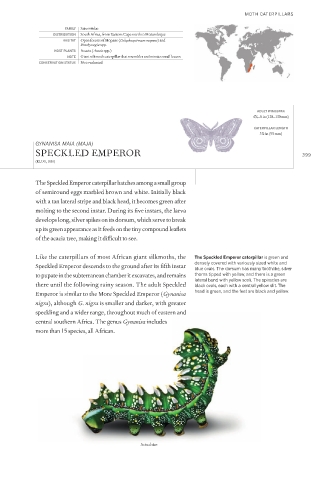
            Like the caterpillars of most African giant silkmoths, the   The Speckled Emperor caterpillar is green and

            Speckled Emperor descends to the ground after its  fth instar   densely covered with variously sized white and
                                                               blue ovals. The dorsum has many toothlike, silver
            to pupate in the subterranean chamber it excavates, and remains   thorns tipped with yellow, and there is a green
            there until the following rainy season. The adult Speckled   lateral band with yellow scoli. The spiracles are
                                                               black ovals, each with a central yellow slit. The
            Emperor is similar to the More Speckled Emperor (Gynanisa   head is green, and the feet are black and yellow.
            nigra), although G. nigra is smaller and darker, with greater
            speckling and a wider range, throughout much of eastern and
            central southern Africa. The genus Gynanisa includes
            more than 15 species, all African.


                                              Actual size

