


Page 408 - The Book of Caterpillars: A Life-Size Guide to Six Hundred Species From Around the World
P. 408
MOTH CATERPILLARS

                                                     FAMILY  Saturniidae
                                                 DISTRIBUTION  Southern (predominantly southeastern) Brazil, west to northern
                                                          Bolivia, and south to northeastern Argentina
                                                    HABITAT  Forests or scrublands
                                                  HOST PLANTS  Many, incuding Lonicera spp. and Solanum spp.
                                                      NOTE  Striking caterpillar with related species throughout South
                                                          American tropical latitudes
                                             CONSERVATION STATUS  Not evaluated


            ADULT WINGSPAN
           2¾–3⅞ in (70–98 mm)
           CATERPILLAR LENGTH
             3 in (75 mm)
                                                                       LEUCANELLA VIRIDESCENS
                                               LEUCANELLA VIRIDESCENS
    406
                                                                                    (WALKER, 1855)


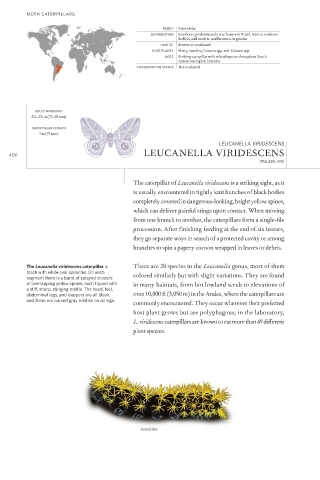
                                            The caterpillar of Leucanella viridescens is a striking sight, as it
                                            is usually encountered in tightly knit bunches of black bodies
                                            completely covered in dangerous-looking, bright yellow spines,
                                            which can deliver painful stings upon contact. When moving
                                            from one branch to another, the caterpillars form a single- le

                                            procession. After finishing feeding at the end of six instars,
                                            they go separate ways in search of a protected cavity or among
                                            branches to spin a papery cocoon wrapped in leaves or debris.


          The Leucanella viridescens caterpillar is   There are 28 species in the Leucanella genus, most of them
          black with white oval spiracles. On each   colored similarly but with slight variations. They are found
          segment there is a band of splayed clusters
          of overlapping yellow spines, each tipped with   in many habitats, from hot lowland scrub to elevations of
          a sti  , sharp, stinging bristle. The head, feet,
          abdominal legs, and claspers are all black,   over 10,000 ft (3,050 m) in the Andes, where the caterpillars are
          and there are curved gray bristles on all legs.   commonly encountered. They occur wherever their preferred
                                            host plant grows but are polyphagous; in the laboratory,
                                            L. viridescens caterpillars are known to eat more than 49 di erent

                                            plant species.


                                              Actual size

