


Page 404 - The Book of Caterpillars: A Life-Size Guide to Six Hundred Species From Around the World
P. 404
MOTH CATERPILLARS

                                                     FAMILY  Saturniidae
                                                 DISTRIBUTION  Southern Canada, most of the United States east of
                                                          the Rocky Mountains
                                                    HABITAT  Forested areas where host plants can be found
                                                  HOST PLANTS  Decidous trees and bushes, including cherry (Prunus spp.),
                                                          oak (Quercus spp.), maple (Acer spp.), Sweetgum (Liquidambar
                                                          styraci  ua ), and Tree of Heaven (Ailanthus altissima)
                                                      NOTE  One of the largest North American caterpillars
                                             CONSERVATION STATUS  Not evaluated, but common throughout most of its range


            ADULT WINGSPAN
             6	    in (152 mm)
           CATERPILLAR LENGTH
             4½ in (114 mm)
                                                                         HYALOPHORA CECROPIA
                                                                CECROPIA MOTH
    402
                                                                                   (LINNAEUS, 1758)


                                            Newly hatched from large, cream-colored eggs mottled in
                                            reddish brown, Cecropia Moth caterpillars are black and covered
                                            in bristles. Although eggs may be laid in small groups, the larvae

                                            are solitary feeders and quickly go o  on their own. When they
                                            enter the second instar they are yellow and still covered in black
                                            bristles growing from tubercles that will become blue, orange,
                                            or yellow. It is when the caterpillars reach the third instar
                                            that they begin to take on the stunning colors for which they

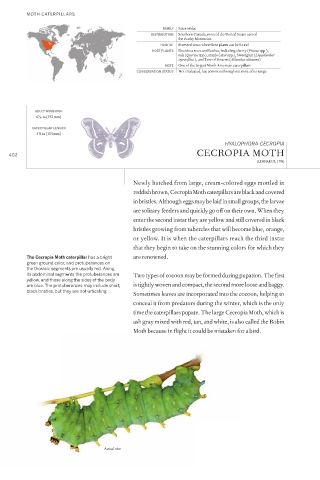
          The Cecropia Moth caterpillar has a bright   are renowned.
          green ground color, and protuberances on
          the thoracic segments are usually red. Along

          its abdominal segments the protuberances are   Two types of cocoon may be formed during pupation. The  rst
          yellow, and those along the sides of the body
          are blue. The protuberances may include short,   is tightly woven and compact, the second more loose and baggy.
          black bristles, but they are not urticating.  Sometimes leaves are incorporated into the cocoon, helping to
                                            conceal it from predators during the winter, which is the only
                                            time the caterpillars pupate. The large Cecropia Moth, which is
                                            ash gray mixed with red, tan, and white, is also called the Robin
                                            Moth because in  ight it could be mistaken for a bird.


                                  Actual size

