


Page 411 - The Book of Caterpillars: A Life-Size Guide to Six Hundred Species From Around the World
P. 411
MOTH CATERPILLARS

                      FAMILY  Saturniidae
                  DISTRIBUTION  Guiano-Amazonian basin, from the Atlantic to the eastern Andes,
                           south to central Brazil and northern Bolivia
                     HABITAT  Forests and scrub, tropical to temperate
                  HOST PLANTS  Unknown; in captivity has fed on privet (Ligustrum spp.)
                           and Laural Sumac (Malosma laurina)
                      NOTE  Stinging caterpillars that en masse can fatally injure humans
             CONSERVATION STATUS  Not evaluated


                                                                                   ADULT WINGSPAN
                                                                                  2¾–4½ in (70–114 mm)
                                                                                  CATERPILLAR LENGTH
                                                                                    3 in (75 mm)
            LONOMIA ACHELOUS
            LONOMIA ACHELOUS                                                                     409

            (CRAMER, 1777)


            The black, newly hatched caterpillar of Lonomia achelous eats
            its eggshell before following the pheromone-laced silk trail of its

            siblings to join them. In the  rst instar, it possesses two pairs of
            long tubercles with forked tips arising from the second and third
            segments. As it grows, the larva changes shape, color, and the
            arrangement of its spines. The caterpillars are strictly nocturnal,
            feeding in the treetop by night and “galloping” fast in procession
            down the tree trunk to amass on the base each morning. When
            it has finished feeding, the caterpillar pupates among debris
            without a silk cocoon.


            Stings from Lonomia caterpillars cause fatalities every year
            when people inadvertently come in contact with many larvae
            at once. However, the sting of a single L. achelous caterpillar is
            not dangerous, and the pain is not as intense as that caused by
            some other species in the Hemileucinae subfamily. The adult,
            a species of giant silkmoth, is only moderately sized and
            resembles a dead leaf.


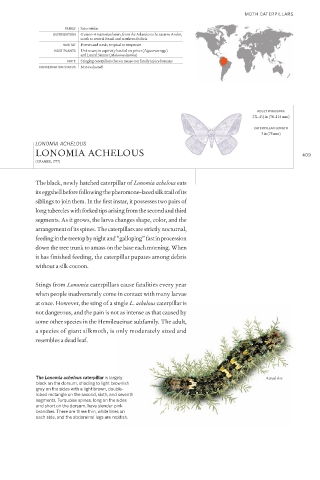
             The Lonomia achelous caterpillar is largely                              Actual size
             black on the dorsum, shading to light brownish
             gray on the sides with a light brown, double-
             lobed rectangle on the second, sixth, and seventh
             segments. Turquoise spines, long on the sides
             and short on the dorsum, have slender pink
             branches. There are three thin, white lines on
             each side, and the abdominal legs are reddish.

