


Page 412 - The Book of Caterpillars: A Life-Size Guide to Six Hundred Species From Around the World
P. 412
MOTH CATERPILLARS

                                                     FAMILY  Saturniidae
                                                 DISTRIBUTION  East and southeast African coastal areas, from Somalia south to
                                                          South Africa
                                                    HABITAT  Tropical forest patches and savannahs
                                                  HOST PLANTS  Many, including Bauhinia spp. and Wild Fig (Ficus chordate)
                                                      NOTE  Large-headed caterpillar that is edible
                                             CONSERVATION STATUS  Not evaluated


            ADULT WINGSPAN
           4–4½ in (100–115 mm)
           CATERPILLAR LENGTH
             3⅜ in (85 mm)
                                                                         MELANOCERA MENIPPE
                                                         CHESTNUT EMPEROR
    410
                                                                                   WESTWOOD, 1849


                                            The Chestnut Emperor caterpillar is all black when it hatches
                                            from its brown-and-white mottled egg. It soon joins its siblings
                                            on a leaf, where they begin feeding. In captivity, the caterpillars
                                            have fed on Hong Kong Orchid leaves (Bauhinia blakeana) for
                                            73 days, only during daylight, developing through six instars,

                                            before evacuating their guts and wandering around to  nd a
                                            place to bury themselves and pupate in the soil. When day length
                                            and climatic conditions are right, the beautiful, chestnut-red
                                            adult crawls out and spreads its wings.


                                            There are eight species of Melanocera throughout Africa. Adults
                                            are similar in color and size but with identifying di erences. The

                                            caterpillars of the Chestnut Emperor, like those of other African
                                            wild silkmoths, are used for food by humans. Women climb
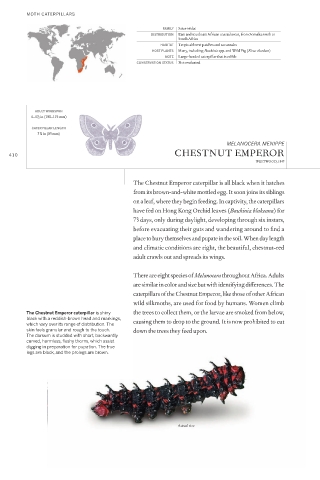
         The Chestnut Emperor caterpillar is shiny   the trees to collect them, or the larvae are smoked from below,
         black with a reddish-brown head and markings,   causing them to drop to the ground. It is now prohibited to cut
         which vary over its range of distribution. The
         skin feels granular and rough to the touch.   down the trees they feed upon.
         The dorsum is studded with short, backwardly
         curved, harmless,   eshy thorns, which assist
         digging in preparation for pupation. The true
         legs are black, and the prolegs are brown.


                                                          Actual size

